
Maxwell I. Gold, anOther Mythology. Interstellar Flight Press, 2023. ISBN 978-1-9537-3624-6. $14.99.
Reviewed by Lisa Timpf
 anOther Mythology is a collection of horror prose-poetry re-imagining myths from a queer perspective, penned by Maxwell I. Gold, a five-time Rhysling Award nominee, and twice Pushcart nominated Jewish American author of prose poetry and short stories in cosmic horror and weird fiction. Gold’s books include Oblivion in Flux: A Collection of Cyber Prose from Crystal Lake Publishing and Bleeding Rainbows and Other Broken Spectrums from Hex Publishers. With this background, it’s not surprising that he is able to craft a compelling collection that is often humorous, sometimes darkly so. Publisher Interstellar Flight Press is an indie speculative publishing house that aspires to spotlight “innovative works from the best up and coming writers” in science fiction and fantasy, so this different approach to mythology is right up their alley.


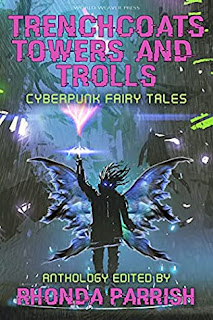 In Trenchcoats, Towers, and Trolls, the third and last in the “Punked Up Fairy Tales” series, which also includes Grimm, Grit, and Gasoline and Clockwork, Curses, and Coal, Rhonda Parrish brings together twelve cyberpunk tales in a collection that is both engrossing and thought-provoking. Edmonton, Alberta-based anthologist and author Parrish is no newcomer to the anthology game: she has edited a number of other themed collections, including one about swashbuckling cats and an “Elemental Anthologies” series.
 Set in 2255 C.E., The House of Styx provides an intriguing view of what a human colony on—or rather, above—Venus might look like a couple of centuries into the future. The novel, slated to be the first in the Venus Ascendant series, is set 250 years before Künsken’s The Quantum Magician. The House of Styx revolves around the D’Aquillon family. George-Étienne D’Aquillon, his sons Jean-Eudes and Pascal, and his grandson Alexis live on the Causapscal des Profondeurs, a habitat fashioned, as are many of the living places in Venus’s clouds, within one of the Venusian cloud-dwelling plants called trawlers.
 Montréal resident Su J. Sokol’s novel Zee follows the life of a girl named Zee from birth to young adulthood as she struggles to deal with her talent for ESP. Sokol’s book delves into the feelings and the experiences of the title protagonist, as well as the four adults who care about her. Zee is not the author’s first published work; in addition to several short stories, Sokol has also penned two other novels, Cycling to Asylum, which has been optioned for development into a feature-length film, and Run J Run, published in 2019 by Renaissance Press. Zee’s publisher, Mouton noir Acadie, is an imprint of New Brunswick-based Bouton d’or Acadie Publishing. Bouton d’or Acadie declares “inclusion, accessibility and diversity” to be core values. Zee aligns well with these those ideals, featuring racial diversity among its key characters, and depicting queer relationships in a positive and matter-of-fact light.
 For those who are tired of books and movies about hapless princesses who sit on their hands and wait for a prince to rescue them, K. Eason’s space opera How Rory Thorne Destroyed the Multiverse provides a welcome breath of fresh air. Released in 2019, the novel serves as book one of the Thorne Chronicles. Book two, titled How the Multiverse Got Its Revenge, appeared in 2020.
 Luna Station Quarterly, which has been in operation for just over a decade, has as its mission “to display the vast and varied talents of women-identified speculative fiction writers.” Issue 41 of the Quarterly, published in March 2020, includes 15 stories, with a roughly even split between fantasy and science fiction.
 In Seeds and Other Stories, Canadian author Ursula Pflug brings us 26 speculative tales, the vast majority of which have been previously published in venues including Dead North Anthology, Transversions: An Anthology of New Fantastic Literature, Tesseracts 21: Nevertheless, The Peterborough Review, and Prairie Fire. With over 70 published short stories to her credit, as well as two other short story collections and three novels, Pflug is an accomplished writer, and that shows in the polished prose offered in Seeds and Other Stories. This particular collection, as is the case with Pflug’s novel Motion Sickness and her novella Mountain, was published by Canada’s Inanna Publications, which describes itself as “one of only a very few independent feminist presses in Canada committed to publishing fiction, poetry, and creative non-fiction by and about women.”


