
Sam Kyung Yoo, Small Gods of Calamity. Interstellar Flight Press, 2024. Pp. 151. ISBN 978-1-953736-28-4. $9.99.
Reviewed by Julie Reeser
 Small Gods of Calamity is a debut novella by Sam Kyung Yoo, who has had a short but illustrious career publishing stories in magazines such as Fantasy and Strange Horizons, with work showcasing themes of East Asian folklore and ghosts. This foundation has served them well for this strikingly emotional urban fantasy, set in Seoul, a landlocked city. Kim Han-gil is investigating an apparent suicide when he smells the sea. This is his first clue that his past has once again caught up with him, and that the death at his feet is something much more sinister. Because that smell isn’t actually the sea, it’s a spirit.


 Over the last few years, I’ve established a personal habit of spending time each morning planning my day with a view toward my yearly goals and reading poetry. When I saw the Unicorn Death Moon Day Planner by Zachary Cahill, I anticipated an experience born of this complimentary companionship—a planner interspersed with art and poetry to inspire—it seemed the perfect match. Zachary Cahill has quite a few projects and titles under his writerly belt, including a graphic novel, a debut novel, a directorship, and being editor-in-chief of Portable Gray. Both his art and poetry have been shown in several prestigious settings.
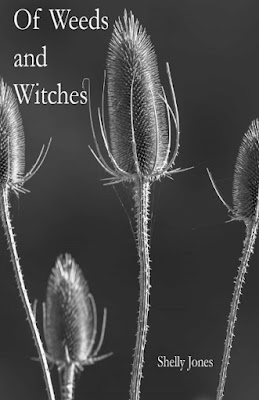 Shelly Jones is an educator, author, and researcher nominated for a Pushcart Prize, a Dwarf Star Award, and she has been a finalist for the Best Microfiction 2023. Their chapbook, Of Weeds and Witches, contains twenty-four poems that thrum with mythical magic. Nature lurks and drips from the lines, midwifed by women seeking power, revenge, or escape. The
 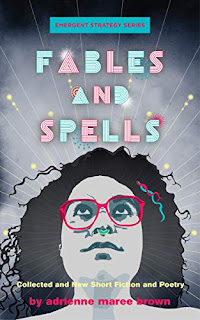 When I first encountered the work of adrienne marie brown, it was through her book, Emergent Strategy. That book showed me a gap in my existence and began the process of filling it in. brown introduced to me the concept of moving through systems in nonlinear and creative ways with whole minds, bodies, and communities. She embraces this perspective again in her new release, Fables and Spells: Collected and New Short Fiction and Poetry. The book is long and complex, ever-shifting like an octopus exploring the environment. It challenges the reader to find a place of relaxed alertness while acknowledging the pain of both change and stagnancy. brown is one of the few writers who makes the reader inescapably aware of the body—not just the reader’s body, but all bodies in space and time and politics. Her work and activism are tender and confident like a practiced lover, alive and breathing.
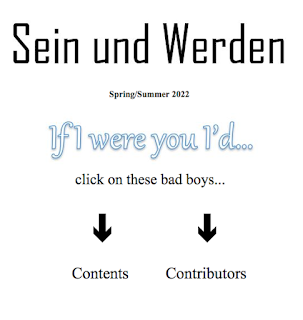 Sein und Werden, per their onsite manifesto, is a quarterly online and occasional print journal whose goal is to invoke Werdenism, a term coined by the editor to encompass her modern aesthetic vision of “being and becoming” taken from the Expressionists. Each issue is themed, and this one starts with a prompt of “If I were you…” This is carried cutely by the home page where you are directed to a choice between two arrows: content or contributors. The overarching or underlying philosophy of the works chosen revolve around Existentialism, Surrealism, and Expressionism.
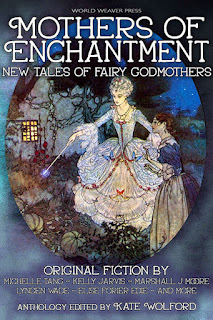 The best part of fairy tales for me isn’t the reversal of fortunes or the justice delivered. For me, it’s always been the slantwise magic that follows rules we can’t see—an early form of magical realism wherein the burdened and despairing characters find relief. This wild magic often arrived in the form of a fairy godmother, subverting the ill-fated mothers and scary stepmothers sprinkled like blood stains over the pages. The fairy godmother feels deserved and arbitrary at the same time, allowing a reader centuries in the future to believe that they, too, might one day be magicked into a gorgeous gown and a happily ever after. And as Wolford points out in her introduction, “many people transform our lives with simple generosity and kindness.” We all have that magic within us.
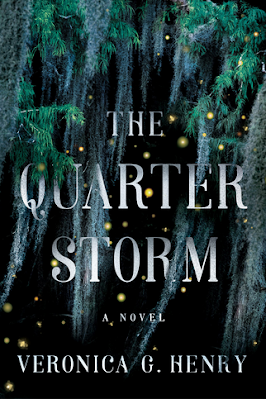 Veronica G. Henry is not from New Orleans and does not practice Vodou, but she consulted experts for both, and this careful consideration shines in details and authorial voice in her mystery novel The Quarter Storm. Unlike many past representations of Vodou, Henry focuses on the history and faith, and leaves the fetishization behind. This second book is a departure for Henry from the dark fantasy of an evil carnival, and instead brings characters who could easily be found during a walk through your city, and a murder that feels ripped from the headlines. (I originally assumed this book was self-published due to the surprisingly neutral and forgettable cover for the ebook; 47North turns out to be an imprint of Amazon Publishing, and they offer their acquistions through Kindle Unlimited—which is how I found it—as well as paperback and audio editions.)
 Fusion Fragment was re-launched in March 2020 as a semi-pro SF market. The cost of the current issue is pay-what-you-can for digital, and back issues are free to read on the website; backing the