
Lightspeed Magazine, ed. John Joseph Adams & Wendy N. Wagner. Issue 168 (May 2024). Online at lightspeedmagazine.com.
Reviewed by Storm Blakley

Lightspeed June 2024 has both sci-fi and fantasy, short stories and flash. Both sci-fi short stories offered commentary on war, while the fantasy short stories each focused on belief, and gods. The sci-fi flash stories focused on relationships, while the fantasy flash stories speak from the perspective of creatures far older and wiser than humanity.


 Small Gods of Calamity is a debut novella by Sam Kyung Yoo, who has had a short but illustrious career publishing stories in magazines such as Fantasy and Strange Horizons, with work showcasing themes of East Asian folklore and ghosts. This foundation has served them well for this strikingly emotional urban fantasy, set in Seoul, a landlocked city. Kim Han-gil is investigating an apparent suicide when he smells the sea. This is his first clue that his past has once again caught up with him, and that the death at his feet is something much more sinister. Because that smell isn’t actually the sea, it’s a spirit.
 Kaleidotrope’s Autumn 2023 issue offers a wonderful collection of fantasy, sci-fi and a little horror. Each poem and story held, for me, a reflection on very fundamentally human needs and ideals, from a delightful array of differing perspectives.
 Over the last few years, I’ve established a personal habit of spending time each morning planning my day with a view toward my yearly goals and reading poetry. When I saw the Unicorn Death Moon Day Planner by Zachary Cahill, I anticipated an experience born of this complimentary companionship—a planner interspersed with art and poetry to inspire—it seemed the perfect match. Zachary Cahill has quite a few projects and titles under his writerly belt, including a graphic novel, a debut novel, a directorship, and being editor-in-chief of Portable Gray. Both his art and poetry have been shown in several prestigious settings.
 Shelly Jones is an educator, author, and researcher nominated for a Pushcart Prize, a Dwarf Star Award, and she has been a finalist for the Best Microfiction 2023. Their chapbook, Of Weeds and Witches, contains twenty-four poems that thrum with mythical magic. Nature lurks and drips from the lines, midwifed by women seeking power, revenge, or escape. The
  Jess Hyslop’s Miasma is a book that I wish had been around when I was younger. It’s a novella that would have fit nicely in the fantasy works of the 1990s that I spent my teenage years reading, but with a revisionist approach. It takes a variety of elements any reader of secondary world fantasies will recognize—knights, mages, monstrous lizards, a dangerous swamp—and reworks them into something fresh for the 2020s. Part of Luna Press’s novella series, Miasma clocks in at just under 100 pages, but Hyslop doesn’t waste any of them, wisely choosing not to pad this out to a standard novel length. It has a story and it tells it, directly, forthrightly, with well-drawn human stakes. There’s no saving the world, no prophecies or chosen ones, just a family trying to survive.
 Rachel Rosen’s Cascade is the first book of a trilogy, The Sleep of Reason, alluding to Goya’s etching of the same title, in which a young man is sleeping on his desk and swarms of bats, owls, and other denizens of the dark flock towards him—or is it from his dreaming brain? The titular Cascade refers to the major cataclysmic shift that has occurred an indefinite period before the novel’s start, resulting in weird occurrences, like cracks appearing in the surface of the earth, people being transformed into demons, the sprouting of “shriekgrass” to replace edible crops, and the general appearance of magic. As one major character, a wizard, puts it, the question is not what can we do to preserve our way of life, but what does magic want?
 Strange Horizons’ November issues have a lot to say, and in them, I saw a reflection of much happening in the world today, from the climate crisis to the digital world, monsters and magic and far-away planets. Stories and poems about communities standing together, of breaking free of what chains us, of creating a better world for those to come (including ourselves); these issues really resonated with me.
 When I first encountered the work of adrienne marie brown, it was through her book, Emergent Strategy. That book showed me a gap in my existence and began the process of filling it in. brown introduced to me the concept of moving through systems in nonlinear and creative ways with whole minds, bodies, and communities. She embraces this perspective again in her new release, Fables and Spells: Collected and New Short Fiction and Poetry. The book is long and complex, ever-shifting like an octopus exploring the environment. It challenges the reader to find a place of relaxed alertness while acknowledging the pain of both change and stagnancy. brown is one of the few writers who makes the reader inescapably aware of the body—not just the reader’s body, but all bodies in space and time and politics. Her work and activism are tender and confident like a practiced lover, alive and breathing.
 The story begins in a gambling joint in Goetia, a mining town in the mountains run by a privileged elite. It’s an unholy place and Celeste, a dealer at the card tables of the Eden, “Perdition Street’s premiere gambling and drinking establishment,” has seen her share of squalor, degradation, and exploitation and there’s the obligatory saloon-fight in the first ten pages. But when her sister Mariel, a singer at the Eden, is arrested for a particularly nasty murder, Celeste is forced to embark upon a quest to prove her sister’s innocence. In doing so, she sees even more of the town’s darker side than she ever thought existed.
 If you tried to reverse engineer the contents of Issue 363 of the literary adventure fantasy online magazine Beneath Ceaseless Skies, you might find a writing prompt in your hand: tell a tale of thwarted immortality. That probably isn’t actually the origin of the two new stories published in the issue, of course. It’s more likely that an editor decided that these two new stories belonged together because of that similarity at their core. Either way, what’s interesting is that these two new stories taking thwarted immortality as a premise are nothing like each other.
 Fireside Magazine was—and, yes, I must sadly say was—a online publisher of short stories, poems, and novels. Founded in 2012, it’s had a respectable 10-year run, at first based on crowdfunding, then on subscriptions. But now Fireside’s operations are now winding down. Issue 103 (Summer 2022) represents the magazine’s final offering of stories to the world.
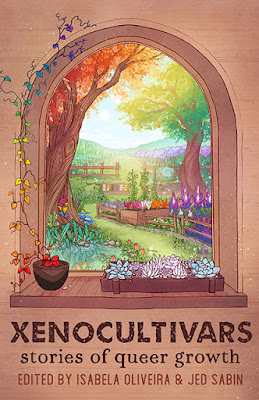 Confession time: I wanted to submit to this one, but something came up, where “something” is “my own laziness.” But, having read it, I’m now glad I didn’t submit, because I probably would have dragged down the average. When Speculatively Queer launched last year with the triumphant It Gets Even Better: Stories of Queer Possibility, it stepped into an under-served market: Full-length queer SFF short stories. Consequently, a lot of us have been keeping an eye on it. Xenocultivars, its sophomore publication, is a very strong follow-up, and a sign that Speculatively Queer may be a formidable new contender.
 Sein und Werden, per their onsite manifesto, is a quarterly online and occasional print journal whose goal is to invoke Werdenism, a term coined by the editor to encompass her modern aesthetic vision of “being and becoming” taken from the Expressionists. Each issue is themed, and this one starts with a prompt of “If I were you…” This is carried cutely by the home page where you are directed to a choice between two arrows: content or contributors. The overarching or underlying philosophy of the works chosen revolve around Existentialism, Surrealism, and Expressionism.
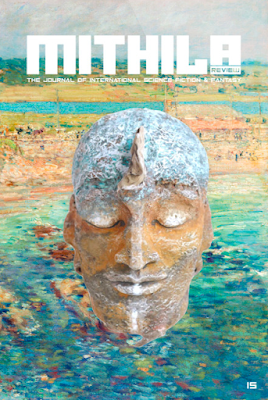 Mithila Review, founded in 2015, is a science fiction and fantasy magazine based in India but international in scope. This is a promise Mithila absolutely delivers on, for not only does it contain stories from all over, the magazine’s own gaze looks firmly out from its non-Western corner of the world and this is a wonderful thing. About half of the stories in the magazine are told from an Indian perspective and it’s a delight to read the stories that look out at the future and the effects of global events through the eyes, hearts, and experiences of people and places many of us are not used to inhabiting in fiction, given the Anglosphere’s publishing industry’s gatekeeping in favor of white, Western authors. It helps that the stories, articles, and poems in Mithila Review lean into the literary and are written handsomely and at times in an English that is perfect yet non-Western in tone. This deepens the flavor of these works and befits a magazine that is named for a distinct geographic, cultural, and linguistic region with ancient roots that is now split by the border between India and Nepal and grappling with attempts at political control and cultural and linguistic assimilation from two different countries.
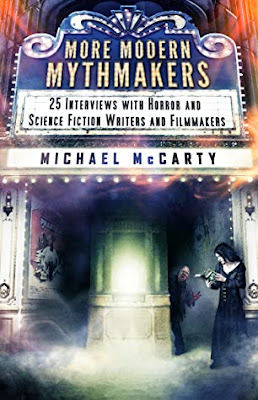 Michael McCarty has published dozens of books, especially non-fiction work about genre writers and artists. Crystal Lake Publishing is a relative newcomer, but they’ve already started distinguishing themselves by having a good eye for talent and publishing books that enhance the horror and science fiction community. More Modern Mythmakers is a strong collection of interviews that are a testament to McCarty’s access and eye, and the book would make a nice addition to your shelf, but it has some shortcomings that make it less than completely successful for a book of its kind.
 The April “2k22” issue, entitled “Experimental Realms,” completes the second full year of publication of Penumbric following a fifteen-year hiatus. “Experimental Realms” is also one of Penumbric magazine’s roughly annual special “art and prose” issues. There is certainly no shortage of either (plus poetry) in the issue; 78 numbered pages thick, it features nine speculative fiction tales, six poems, and, including the cover, seven works of art as well as panels and notes relating to the webcomic Mondo Mecho.
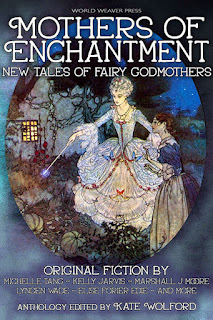 The best part of fairy tales for me isn’t the reversal of fortunes or the justice delivered. For me, it’s always been the slantwise magic that follows rules we can’t see—an early form of magical realism wherein the burdened and despairing characters find relief. This wild magic often arrived in the form of a fairy godmother, subverting the ill-fated mothers and scary stepmothers sprinkled like blood stains over the pages. The fairy godmother feels deserved and arbitrary at the same time, allowing a reader centuries in the future to believe that they, too, might one day be magicked into a gorgeous gown and a happily ever after. And as Wolford points out in her introduction, “many people transform our lives with simple generosity and kindness.” We all have that magic within us.
 Mythaxis Magazine, if you haven’t previously had the pleasure, is currently a quarterly online magazine of speculative fiction that feels like a glimpse into the internet we could have had, had we not allowed it to turn into a virtual shopping mall, a brewer of bullying, and a weaponized spreader of disinformation. Free to read and free from advertisements, Mythaxis is a labor of love that will take you strange places and feed you amazing ideas just because excellence is an excellent endeavor. The stories that Mythaxis serves as a portal to are exactly the sorts of stories you hope you would be true enough to your ideals to produce, if you had that kind of talent. Or, at least that’s how it feels to me. People with talent should be doing great things with it, not just the same old thing, averagely, already done by everyone else.
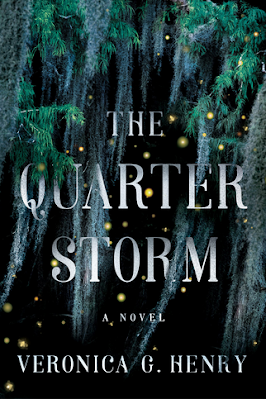 Veronica G. Henry is not from New Orleans and does not practice Vodou, but she consulted experts for both, and this careful consideration shines in details and authorial voice in her mystery novel The Quarter Storm. Unlike many past representations of Vodou, Henry focuses on the history and faith, and leaves the fetishization behind. This second book is a departure for Henry from the dark fantasy of an evil carnival, and instead brings characters who could easily be found during a walk through your city, and a murder that feels ripped from the headlines. (I originally assumed this book was self-published due to the surprisingly neutral and forgettable cover for the ebook; 47North turns out to be an imprint of Amazon Publishing, and they offer their acquistions through Kindle Unlimited—which is how I found it—as well as paperback and audio editions.)