J.R. Mabry, The Where, the Who & the What: A Gnostic Science Fiction Novel. Apocryphile Press, 2025. Pp. 668. ISBN 978-1-958061-92-3. $24.99 pb/$0.99 e.
Reviewed by Don Riggs

Reviewed by Don Riggs
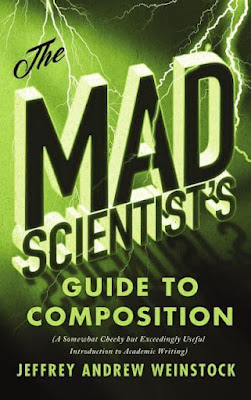 I have taught from Weinstock’s Mad Scientist’s Guide to Composition for three years now, and have found it to be extremely useful in presenting the basic principles of academic writing for students, including what instructors call the “mechanics” of writing, including punctuation, paragraphing, and transitions; finding and using sources for research papers (helpfully called “Graverobbing” with a nod to Victor Frankenstein); preliminary stages like brainstorming and outlining; “Conducting Experiments” as a way of developing strategies for informing, persuading, and evaluating; and in a stirring chapter, “The Monster Lives!” providing approaches to revising, peer review, and retroactive outlining; and finally, “Placating Ghosts,” or documenting sources “to Avoid Angering the Dead… and the Living.” In other words, a very conventional approach to forming and formulating an argument… but presented in the guise of horror movie tropes.
Reviewed by Don Riggs
 Vyvyan Evans is a professional linguist with an extensive interest in online technology and publishes in academic journals as well as magazines such as Psychology Today and The New Republic, so his credentials in the real-world fields of linguistics and computer tech are impressive. The Babel Apocalypse, however, is not like Neal Stephenson’s Snowcrash, although it has a somewhat similar sinister plot to gain world domination through manipulating people’s minds via language. For one thing, there is a definitely Western European cast to the characters and setting: Emyr Morgan, the protagonist, is English, though with his home in Wales, and is a James Bond-007-type of secret agent, a commander in Europol, who has relationships with various highly placed women, in which he is not always completely in control. His house is in the Netherlands, in a fishing village called Scheveningen, the name of which was used as a Shibboleth to detect Germans impersonating Dutch nationals at the beginning of World War II. This is not mentioned in the novel, although it might be a very esoteric Easter Egg.
Reviewed by Don Riggs
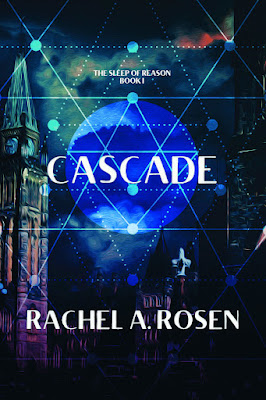 Rachel Rosen’s Cascade is the first book of a trilogy, The Sleep of Reason, alluding to Goya’s etching of the same title, in which a young man is sleeping on his desk and swarms of bats, owls, and other denizens of the dark flock towards him—or is it from his dreaming brain? The titular Cascade refers to the major cataclysmic shift that has occurred an indefinite period before the novel’s start, resulting in weird occurrences, like cracks appearing in the surface of the earth, people being transformed into demons, the sprouting of “shriekgrass” to replace edible crops, and the general appearance of magic. As one major character, a wizard, puts it, the question is not what can we do to preserve our way of life, but what does magic want?

Reviewed by Don Riggs
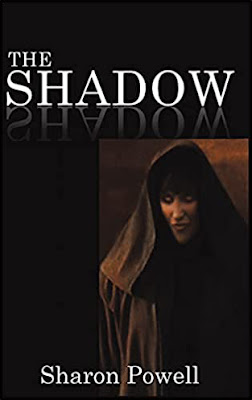 Sharon Powell’s novel The Shadow is idiosyncratic. That it is in the tradition of Frankenstein literature is evident from the name of the central character, Victor Frankenstein. This Frankenstein is a doctor who dissects corpses, but upon finding a young man who has been buried by an avalanche and cryonically preserved, he keeps the young man in the best cold storage possible in early 19th-century central Europe. In overseeing his living but unconscious body, the doctor is surprised by a spiritual visitation: the spirit of the frozen young man appears above the gurney and addresses him, involving the doctor in a plot to rescue a group of children who are “cared for” by one of the most respected men of the village, but who, according to the spirit, has possession of this group of orphans and, in a Dickensian twist, is working them to death. Simon, the spirit, and the doctor team up to locate the orphans to free them, and ultimately bring their tormentor to justice.
Reviewed by Don Riggs
 Simon Lowe’s wearily titled The World Is at War, Again is not actually a war novel, in that there are no pitched battles on land, sea, or in the air, no ever-more-powerful bombs or other instruments of mass destruction. In fact, the only mention of the War itself is the frequently repeated statement that Things Aren’t Going Too Well With The War, the capitalized words indicating that this is a frequently repeated trope that all have heard many times before and probably will again. The identity of the two sides is unclear, except those on the side of seemingly all of the characters are called the “Unified Nations”—which I at first misread as the United Nations. The characters are all spies, specifically Agent Assassins, or AAs, that come from two families, the Misorovs and the Fandanellis. Mr. and Mrs. Fandanelli, whose son Peter is deposited at (or near) a special school for children of AAs, are in the Volunteer War Over Seas Aid Squad (VWOSAS), stationed on a Cruise Liner, to meet an unknown contact in an unknown manner to receive their instructions.
Reviewed by Don Riggs
 Nick Bones Underground is a slipstream novel, combining elements of Science Fiction, Urban Fantasy, and the Crime/Detection genre. It is set in a vague time frame, given that at least one of the characters is a Holocaust survivor, albeit a very old one, and computer technology has advanced into the realm of Artificial Intelligence, which impacts the daily life of the narrator-protagonist, Nicholas Friedman, a professor of Comparative Religions at a university in New York City. Life in the city has been inflected by something which is referred to as the “Great Debacle,” which is never completely explained or defined except at one point as having had to do with computers’ developing a degree of free will and acting in unpredictable ways. The most evident example of this cybernetic behavior comes in the form of Maggie, the A.I. in the apartment of the narrator, who, having become a transgender computer, now yearns to become an incarnation of Marlene Dietrich.
 Reading Skyward Inn now gives me a sense of how it must have felt in the 1960s to read the Nouveaux Romans of Michel Butor, Robbe-Grillet and Marguerite Duras: no intrusive narrator framing the dialogue and events of the fictional world, a radical reduction to just what was happening, or just what was going through the principal character’s mind. In science fiction terms, this means no infodump, no appendixes outlining the background, no maps, no glossary. All we have is Jem, short for Jemima; Isley, who it turns out is from the planet Qita; Jem’s son Fosse; and the people in the Skyward Inn, which is somewhere in the Western Protectorate. This last seems to be separate from… well, the rest of the world, I think, and is not far from the Kissing Gate, which I take to be a portal through which spaceships can travel to the planet Qita.
 Kristine Kathryn Rusch blogged on August 5, 2020 that courage was essential when starting to write as a serious endeavor. Not commendations and blurbs from established authors, or traditional publishing holding your hand and walking you through the steps to your first book’s appearance on the market, but courage to do what you feel impelled to do: writing and putting your book into print and out there, even without the mark of an impressive publisher embossed on the jacket.
 Sometimes you have to travel far to find some treasure near home. This was the case with this book, published by a small press in my home city of Philadelphia, PA; I picked up The Vampire Gideon’s Suicide Hotline at the Conference for the Fantastic in the Arts in Orlando, FL two years ago. Because I do not ordinarily read horror or vampire fiction, I shelved it until recently when, unable to go out to libraries or bookstores because of the pandemic, I read it, and found I could not put it down. The title summarizes the basic situation of the story: Gideon—being the vampire’s name, rather than a reference to the Gideon Bible—operates an informal suicide hotline. Several of his regular callers show him at work, de-escalating their emotional states until they have gone beyond the likelihood that they will take their lives. Or, alternatively, until they do. One of his regulars tells him he should not be operating this telephone hotline, as he has no training. Gideon’s final argument against his callers’ killing themselves is that he knows death is not a solution for their despair, because they have not died. He has.


 Professor carrington’s focus in Speculative Blackness is on the interactions among not only science fiction, but other speculative fiction categories such as “fantasy, horror, utopia and dystopia, paranormal romance, counterfactual history, magical realism, and so on” (23). The thrust of his book is that the “Whiteness of Science Fiction” or the identification of speculative fiction as a White cultural tradition marks “alienation as a signal feature of Black experiences with the genre” (17-18). To support and illustrate these generalizations, the author presents an array of studies of presence and absence of African Americans in fandom, as demonstrated in fanzines, television’s original Star Trek series, comics, Deep Space Nine and its novelizations, and in a final chapter, he moves into online fanfiction archives involving “Black British-diasporic characters in Harry Potter,” extending his reach beyond the African-American sphere. He does a great deal of investigative work that reveals little-known aspects of the history of fandoms, of fans’ influence on the Speculative Fictional products (books, television shows, films, comics, etc.) that evolve in relation to the fans’ responses to them. As such, this is a reception study, except in the sense that the reception in turn becomes an influence on the subsequent development of the fiction.
 Of the books brought out in time for the 150th anniversary of the publication of Lewis Carroll’s Alice in Wonderland, Anna Patrick’s is the most intensely personal and deeply psychological novel that I have seen. Patrick takes Carroll’s Journey through the Belly of the Whale and emphasizes the shamanic potential of it such that Elizabeth, the protagonist, goes through a confrontation with herself with the intention—not necessarily conscious—of grappling with the darkness within herself and resolving whatever issues she has had that have resulted in her living a life in hiding behind the mask that she has fashioned over the years. Carroll’s Alice has been important for her since a child, and her Alice doll leads her on into the rabbit-hole and through the various Stations of the Wonderland, abbreviated from the sequence of places and events in the original novel.
 When I first started reading this very readable novel, I thought, this isn’t science fiction; it’s a very well-written mainstream novel set in contemporary Canada and U.S. Then as I was sucked into the narrator and his family, then substitute family, I saw many of the frustrations that I, and I assume many of us have had with families and neighbors who just don’t get us. It was only then, when the protagonist takes a series of diagnostic “exams” for a corporation called InterAlia Inc., that I began to recognize my own experiences with eHarmony and similar matchmaking organizations, and was prepared to go the extra step with this setup to see where it was going to lead.
 In the 1970s, I treasured the small paperback book of Japanese crazy wisdom Zen Flesh, Zen Bones, compiled and translated by Paul Reps and D. T. Suzuki; in addition, the Sufi paperback, translated by Idries Shah, The Exploits of the Incomparable Mulla Nasruddin. Both collections had wisdom stories that often confused and perplexed, but if you thought about them enough, they would make a kind of sense. Well, usually. Zen Master Tova Tarantino Tobshiba is a contemporary companion to, or descendant of, the two collections mentioned above. Like them, the book has mostly quite brief narratives or sometimes koan-like sayings. However, they also seem to have a contemporary American spin on them, and at times the “point” is so obscure—at least, to this reader—that one must assume that either 1) it is working its way against the logical mental grain within, or 2) one just doesn’t get it. Sometimes, I think that the point is that there is no point.
