
Maxwell I. Gold, anOther Mythology. Interstellar Flight Press, 2023. ISBN 978-1-9537-3624-6. $14.99.
Reviewed by Lisa Timpf
 anOther Mythology is a collection of horror prose-poetry re-imagining myths from a queer perspective, penned by Maxwell I. Gold, a five-time Rhysling Award nominee, and twice Pushcart nominated Jewish American author of prose poetry and short stories in cosmic horror and weird fiction. Gold’s books include Oblivion in Flux: A Collection of Cyber Prose from Crystal Lake Publishing and Bleeding Rainbows and Other Broken Spectrums from Hex Publishers. With this background, it’s not surprising that he is able to craft a compelling collection that is often humorous, sometimes darkly so. Publisher Interstellar Flight Press is an indie speculative publishing house that aspires to spotlight “innovative works from the best up and coming writers” in science fiction and fantasy, so this different approach to mythology is right up their alley.


 Whispers in the dark are an excellent site for horror, and offer an important medium in the four stories of The Dark’s February issue.
 The first 2024 issue of The Dark brought us assemblages: entities created out of smaller pieces—sometimes to sinister effect, sometimes to appease a greater menace, and sometimes with good intentions that soured. In all cases, the emerging assemblage speaks to a common struggle or ache in our lives, and that’s where the horror strikes deepest: in the knowledge that these patchwork creations aren’t so far removed from our reality after all.
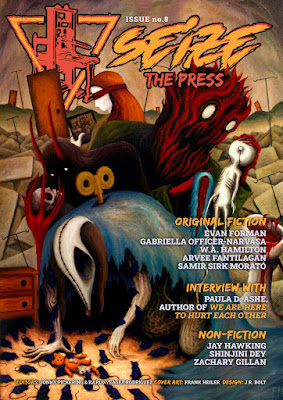 ’Tis autumn, the season of death and endings and remembering things you swore you’d get around to sooner, and that makes three good reasons for me to review the new Seize the Press. You know, the maggot sex one. But is the maggot sex any good, one must ask, or is it merely in there as a selling point for the sort of people for whom such a thing is a selling point (myself, I freely acknowledge, among them)? Let’s find out.
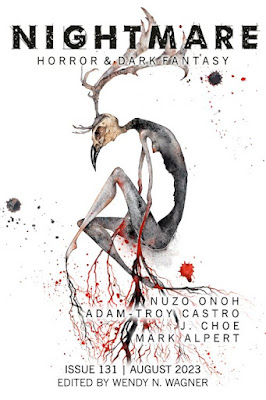 Full disclosure: A little ways back, I attended a Clarion West workshop facilitated by Nightmare’s Managing/Senior Editor Wendy N. Wagner. She was knowledgeable, insightful, and enthusiastic about our work and about making us better writers. I finished the workshop full of ideas and appreciation for the work Wagner is doing in the writing world at large. I am pleased to say I would have enjoyed the August 2023 issue of Nightmare if I’d never met her.
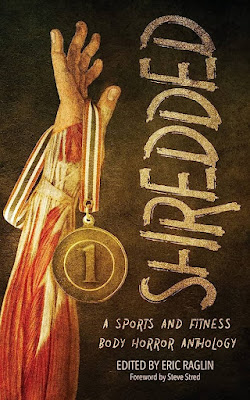 First off: I am not a sports person. The closest I come to a sports horror story is being stuck on the bleachers in the freezing rain waiting for my sister’s track meet to finish. So I wasn’t initially real drawn to Shredded. However, I have full faith in Eric Raglin as a horror editor. Can he overcome my inherent indifference to athletic events? Let’s find out!
 So… this one is weird. And I do not say that lightly. Let me try to describe how this book opens. It opens within the depths of hell, in a wood ringing a field surrounding a giant penis. Buckle up, folks. We’re just getting started.
.jpg) The witches depicted in Avra Margariti’s collection The Saint of Witches are cursed with the burden of knowing, the pressures of womanhood, and the threat that comes with being the other. Dangerous love waits on a blanket under a moonlit tree, and the penalty for being extraordinary is death. Taken as a whole collection, The Saint of Witches doesn’t have one specific narrative line to follow, at least I don’t think, but instead paints a general impression of the lives (and deaths) of witches and those around them. The poems’ speakers are consistent, but I don’t think we’re supposed to understand that voice as belonging to one specific person. If I’m wrong, I don’t think that changes my reading of the pieces, and if I’m right, it doesn’t do anything to diminish the impact with which each individual piece lands.
The witches depicted in Avra Margariti’s collection The Saint of Witches are cursed with the burden of knowing, the pressures of womanhood, and the threat that comes with being the other. Dangerous love waits on a blanket under a moonlit tree, and the penalty for being extraordinary is death. Taken as a whole collection, The Saint of Witches doesn’t have one specific narrative line to follow, at least I don’t think, but instead paints a general impression of the lives (and deaths) of witches and those around them. The poems’ speakers are consistent, but I don’t think we’re supposed to understand that voice as belonging to one specific person. If I’m wrong, I don’t think that changes my reading of the pieces, and if I’m right, it doesn’t do anything to diminish the impact with which each individual piece lands.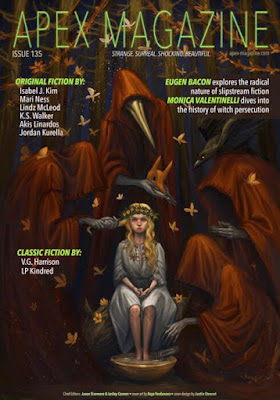 Apex Magazine’s January issue was a collection that made me think of bargains and agreements, and how those can change our perspectives on the things that really matter. Those bargains can be dangerous things, especially when made with powerful beings and magic. Whether we knowingly sign them or not, the consequences are inevitable; some bring about redemption, while others are simply dangerous.
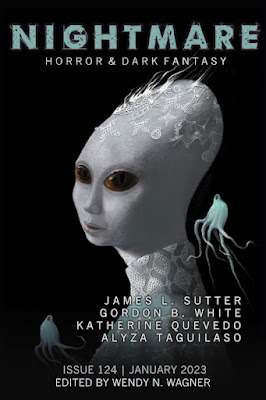 The 124th issue of Nightmare is, for this online magazine of horror and dark fantasy, typically compact, consisting of three short stories, one poem, one essay, one book review, and some author interviews. Freshly freed from holiday hell with the people who are the reason you are in therapy, you might not welcome the news that the issue’s central thread is family. But you might concede that horror has an endless furrow to plow through this topic. None of the stories in this issue of Nightmare go with the obvious. There are no wicked stepmothers here, nor evil children, nor men making Stepford Wives or mummifying their overbearing mothers before moving on to murder women who incite their desires. Instead, the works of fiction mine other dark corners of family life.
 Apex Magazine 2021: The Companion Anthology serves up 48 stories originally published in Apex Magazine in issues 121–128, representing the year the publication bounced back from a brief hiatus. Buying a copy, in either paperback or digital form, is a great way to support an award-winning speculative fiction magazine whose issues are otherwise free to read at the magazine’s website. On the upside, the stories are of generally high quality and come from authors from a variety of places around the world. One entire issue included in the anthology was devoted to Indigenous authors telling speculative fiction stories with Indigenous protagonists—a definite breath of fresh air. But, reader, I warn you, at 544 pages (or 626 if you include front and back matter), the anthology is a long slog through darkness. It's definitely not an anthology built for binge-reading.
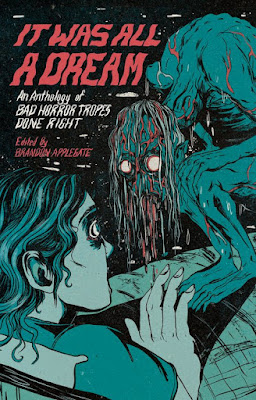 When Hungry Shadow Press announced It Was All a Dream, I was immediately curious and a bit puzzled. The foremost question in my mind: What does it mean to do a trope right? There are many possible answers to this question, and It Was All a Dream showcases all of them. The stories in this anthology fall into four categories: Parodies, metanarratives, inversions, and stories that are played straight. Quite an assortment!
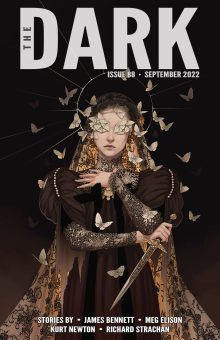 The Dark is a monthly online zine famous for both its excellent dark fiction output and its stringent and remarkably rapid rejections—indeed, while I was working on this review a tweet went somewhat viral from an author irate that they had rejected his manuscript three minutes after he submitted it. It’s a leading venue for modern horror fiction that favors atmosphere over gore, and provides a home both for the big names of the genre and relative newcomers. All four stories in the September 2022 issue are strong entries. Stylistically, they share a clear, realist voice, with rather straightforward narratives. There are flashbacks, and the smartly-paced unveiling of details necessary for the genre, but none are overly experimental or knotty in approach.
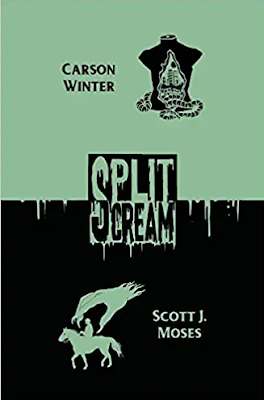 Novelettes and novellas, the red-headed stepchildren of the book world. Too long to place in a magazine and uneconomical to publish on their own, they languish on hard drives, making an occasional appearance as the flagship piece in a single-author collection, but otherwise neglected. Which is a shame, because they’re my fictional first love. About the same length as a TV episode or a graphic novel, they’re a lean, focused form of storytelling, just the right length to fully explore a single arc without needing to detour into subplots. They’re a convenient airport-or-dentist size and they’re nice for those of us who have a bad track record of finishing full-length novels.
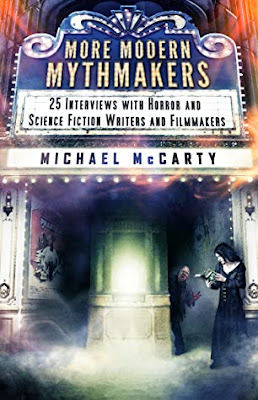 Michael McCarty has published dozens of books, especially non-fiction work about genre writers and artists. Crystal Lake Publishing is a relative newcomer, but they’ve already started distinguishing themselves by having a good eye for talent and publishing books that enhance the horror and science fiction community. More Modern Mythmakers is a strong collection of interviews that are a testament to McCarty’s access and eye, and the book would make a nice addition to your shelf, but it has some shortcomings that make it less than completely successful for a book of its kind.
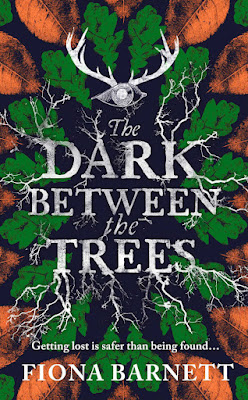 As a Canadian, coming to England has been an interesting experience. Much of Canada’s history prior to the arrival of the European settlers has been forgotten or deliberately lost. So coming to a country where we can walk freely through Neolithic ruins and 2000 year old Roman coins are routinely dug from the river mud is… odd. It is a place that is rife with mystery and secrets—and the potential for horror.
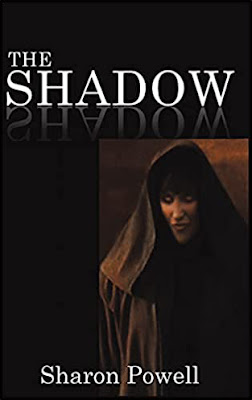 Sharon Powell’s novel The Shadow is idiosyncratic. That it is in the tradition of Frankenstein literature is evident from the name of the central character, Victor Frankenstein. This Frankenstein is a doctor who dissects corpses, but upon finding a young man who has been buried by an avalanche and cryonically preserved, he keeps the young man in the best cold storage possible in early 19th-century central Europe. In overseeing his living but unconscious body, the doctor is surprised by a spiritual visitation: the spirit of the frozen young man appears above the gurney and addresses him, involving the doctor in a plot to rescue a group of children who are “cared for” by one of the most respected men of the village, but who, according to the spirit, has possession of this group of orphans and, in a Dickensian twist, is working them to death. Simon, the spirit, and the doctor team up to locate the orphans to free them, and ultimately bring their tormentor to justice.
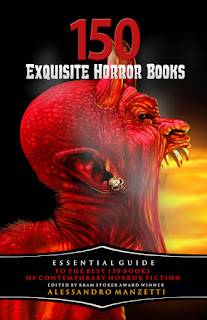 There is an art to creating a “Best of” list, whether that be a “Best of Shakespeare’s Plays” or “Best Singles by Take That.” You are inevitably going to make a lot of people angry. Art and tastes are subjective, and one man’s trash is another person’s treasure. And nowhere is this more true than with horror fiction. Fears are as individual as fingerprints. The film or book that terrify us and make chills run down our spine might make be utterly dull to another. And we horror fans are desperately protective of our best beloveds. I have seen knock-down drag-out fights between fans who can’t agree whether Matthew Stokoe’s Cows is trash or a masterpiece. So creating a volume in which you want to compile the best of modern horror fiction is a bit of a risky endeavour. Fortunately for all of us, Alessandro Manzetti decided to take on the challenge, and he took it on with grace, courage, and a library I can only dream of possessing.
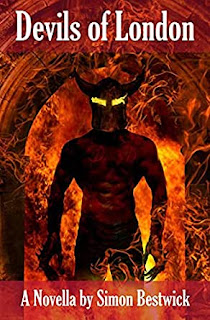 The new novella from British Fantasy Award-nominee Simon Bestwick, out now from Hersham Horror Books, dances between urban fantasy, horror, and social commentary. The story is decidedly British, with British sensibilities and concerns that flavor the narrative throughout its brisk telling. When a story is light on plot, as it is here, success is measured by the story’s execution. Originality. Commentary. A situation that lingers with you long after you’ve finished reading. Devils of London has the pieces to be successful—timeliness, an interesting point-of-view character, high stakes—but ultimately, the execution of the story as a whole falls short of its promise.
 Editor Cécile Cristofari opens Reckoning 5 with a call to action shaped by how pandemic has significantly isolated us from nature; we cannot simply rely on nostalgia to deepen our fight against ongoing natural depreciation from climate change and other human-made devastations. Editor Leah Bobet adds, in her following editorial, that the quest for poetry here was shaped by little intimacies, “flecks of possibility” for reconnection with the world around us, in our most personable and fleeting interactions with the rest of nature.