Showing posts with label surreal. Show all posts

Thursday, June 15, 2023

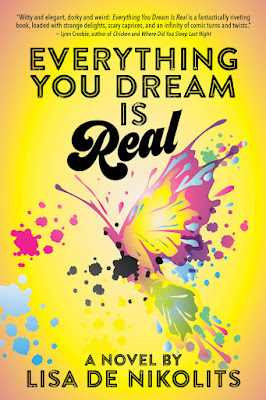
Nikolits, Everything You Dream Is Real (2022)

Lisa de Nikolits, Everything You Dream Is Real. Inanna Publications, 2022. Pp. 323. ISBN 978-1-7713-3930-8. $22.95 pb/$11.99 e.

Reviewed by Christina De La Rocha

As the plot cartwheels, a motley crew of the old, the young, the lovelorn, the pregnant, the queer, the disabled, and the drug-addled overthrow the authoritarian patriarchy whose secret subterranean sex show funds its military operations. You might think what’s not to love? But, argh, for this reader possibly a few things. Your experience may differ, but I found this book frustrating rather than hilariously absurd. Everything You Dream Is Real is truly unique, has a strong voice, and is told by that cast of characters not traditionally represented in fiction, but the premise of the book changes as you move through it. Major details are lobbed in often and out of nowhere to change the direction of the plot in sort of a deus ex machina every couple of pages. I don’t often read a book and keep thinking, ‘well, geez, obviously I am a square,’ but I found this aspect of the book exhausting. I’m happy to go along for a wild ride with thrills and spills and absurdity, but I need to have some idea of the point of it at some stage well before the neatly wrapped up ending. As I’ve said, your experience may differ; I’ll wager the farm that out there in the great, big, wide world there’s a horde of rabid fans of Everything You Dream Is Real. It is that sort of book—one that either alienates you almost entirely or speaks to you so thunderously, it grabs you by the heart and doesn’t let go.

Thursday, February 16, 2023

Schein, Lady Anarchist Café (2022)

Lorraine Schein, The Lady Anarchist Café: Poems and Stories. Autonomedia, 2022. Pp. 110. ISBN 978-1-57027-391-9. $15.95.

Reviewed by Cait Coker

Speculative poetry is an often overlooked genre in the fields of the fantastic, despite a wealth of practitioners in and out of the mainstream. Lorraine Schein’s collection, The Lady Anarchist Café: Poems and Stories, plays with the conventions of both form and language, cannily utilizing wordplay to heighten response and reaction. Consisting of 41 poems and 9 short stories, the volume is a delightful romp across words and worlds.

Tuesday, August 16, 2022

Sein und Werden, (Spring/Summer 2022)

Sein und Werden, ed. Rachel Kendall. Spring/Summer 2022 issue. Online at www.kissthewitch.co.uk/seinundwerden/sein.html

Reviewed by Julie Reeser

Sein und Werden Spring/Summer 2022. If I were you I'd… . click on these bad boys… Contents ContributorsSein und Werden, per their onsite manifesto, is a quarterly online and occasional print journal whose goal is to invoke Werdenism, a term coined by the editor to encompass her modern aesthetic vision of “being and becoming” taken from the Expressionists. Each issue is themed, and this one starts with a prompt of “If I were you…” This is carried cutely by the home page where you are directed to a choice between two arrows: content or contributors. The overarching or underlying philosophy of the works chosen revolve around Existentialism, Surrealism, and Expressionism.

Tuesday, August 03, 2021

Jones, Mirrormaze (2021)

Cliff Jones Jr. (ed.), Mirrormaze: A Dreampunk Anthology. Fractured Mirror Publishing, 2021. Pp. 384. ISBN 978-1-7352171-3-0. $16.99 pb/$8.99 e.

Reviewed by Gwen C. Katz

Fractured Mirror, a newcomer in the publishing scene, has turned out one of the most intriguing and unusual anthologies of the year with Mirrormaze: A Dreampunk Anthology. Dreampunk, coined for this anthology, is an intentionally slippery term to define, but it centers on the sense of unreality created by dreams. It has the deliberately exaggerated aesthetic associated with other punk subgenres, but instead of being defined by a particular era or type of technology, the commonality is the delirious imagery and the underlying feel of not-quite-rightness. It is surreal not just in the colloquial sense of “weird stuff,” but in the original sense of a Jungian journey into the subconscious. Bringing together 20-odd different authors around a concept this nebulous is an ambitious achievement, and I was impressed by how coherent the resultant anthology turned out to be. While I’d never heard the term “dreampunk” before picking up Mirrormaze, within the first couple of stories I immediately had a sense of what it entailed.

Tuesday, June 15, 2021

Café Irreal #78 (2021)

The Café Irreal, International Imagination, ed. G.S. Evans and Alice Whittenburg. Issue 78 (May 2021). Online at cafeirreal.com.

Reviewed by Julie Reeser

The Café Irreal
has been publishing irrrealist fiction as a quarterly webzine for over twenty years. The editor team of G.S. Evans and Alice Whittenburg have a long history of cultivating unusual voices, and rightfully take pride in authors returning to them for publication. Irrealism is a philosophical perspective wherein there is no accepted reality, but rather a search for meaning inside the Sartrean fantastic. I visualize it as if a Magritte painting could be navigated, and indeed, the magazine has a superb collection of ekphrastic images on their Pinterest site if one is seeking inspiration and understanding, and there’s more on the site on how the editors define irrealism.

Saturday, February 29, 2020

Surradia (2019-20)

Surradia: A Retrospective. Musée National d’Art Moderne, 2019–20. Admission €14.00.

Reviewed by Gwen C. Katz

Portrait of Three Women with an Owl

PARIS, France: Some artistic movements are not fully appreciated until after the artists’ time. Some enjoy immediate fame, only to fade from the spotlight as the years pass. And then there are the movements that, through no fault of the artists, never quite have their moment in the sun. Into this third category falls the subject of the Musée National d’Art Moderne (MNAM)’s excellent new exhibition, Surradia: A Retrospective.

Wednesday, November 07, 2018

Pflug, Down From (2018)

Ursula Pflug, Down From. Snuggly Books, 2018. Pp. 96. ISBN 978-1-943813-57-5. $10.14.

Reviewed by Djibril al-Ayad

Down From is the shortish (a little over 20,000 words, I guess), dreamlike, fabulist fifth novel by Ursula Pflug, published by Snuggly Books, purveyors of bite-sized experimental and neo-decadent fiction. This is a classic unreliable narrator story, offering themes of uncertain memory, revelation, magic and reality, and featuring a viewpoint character who is uncertain about her own history, relationship with the thinly sketched secondary characters, and even which world she is in. The first half of the book unsettles with missing memories, shifting character names, stilted conversations—putting us firmly into the mindset of the discombobulated Sandrine. The second half changes both direction and pace, giving us a quite different story than we may have been expecting, albeit no less fabulist and semi-realist, and leaves as many new mysteries as we started with. After a slow start, this book rewards the faithful reader, especially if they love magic, uncertainty, fierce and unapologetic women, and stories within stories (and art within art).

Tuesday, March 08, 2016

Duncan, Testament (2015)

Hal Duncan, Testament. Eibonvale Press, 2015. Pp 398. ISBN 978-1-908125-42-2. £25.00 hb/£10.00 pb.

Reviewed by Cait Coker

Speculative stories that rewrite the Bible (or its offshoots) are common enough to be nearly a dime a dozen; the sort of short story that begins with marooned astronauts on a hostile planet named Adam and Eve is a risible cliché for a reason. In Testament, Hal Duncan rewrites and intersperses the Gospels with commentary from an unnamed author, and if the product is not necessarily new, it is nonetheless absorbing.

Monday, June 08, 2015

Thompson, Rhymer (2014)

Douglas Thompson, The Rhymer: an Heredyssey. Elsewhen Press, 2014. Pp. 192. ISBN 978-1-9081-6841-2. £9.99 pb/ £2.99 e.

Reviewed by Djibril al-Ayad

The Rhymer is the eighth novel by Scottish weird and speculative author and editor Douglas Thompson, published by British small press Elsewhen. This novel is one of the more surreal and absurdist tales Thompson has written, parts of which were previously published in serial or standalone form in other fantastic magazines. It is entirely written in a style somewhere between free-association, free-verse, and comic semi-rhyme, which sounds like it would be hard to read, but actually isn’t, although the story does veer wildly and apparently out of control between satire, grotesque, bizarre, mystical and pseudo-scientific allegory. While I felt this novel sometimes sacrifices plot continuity and character consistency in name of moving the story forwards, it is a bit hard to tell to what degree this is the result of lazy writing, and how much a symptom of the rapidly changing realities in the story itself. I confess to not particularly liking any of the characters, or indeed the narrative voice, but I did find it pleasant to read, challenging in the way that literature should be, and sometimes startlingly original.

Sunday, June 29, 2014

Connell, The Galaxy Club (2014)

Brendan Connell, The Galaxy Club. Chômu Press, 2014. Pp. 202. ISBN 978-1-907681-25-7. £10.00.

Reviewed by Djibril al-Ayad

The latest short novel by inventive and experimental fantasy author Connell, published by the rather wonderful, weird Chômu Press, is typically hard to categorize. Billed as “noir” in the press pack, the book does indeed involve downbeat, not terribly sympathetic characters in various degrees of chronic struggle or desperation and whose conflict in the story is between letting their lives get even worse or scrabbling to hold on with their fingernails for another day, set in a mid-twentieth century American locale. But on the other hand it is also a road novel, with hitchhikers, car chases, lonely towns to pass through and creepy strangers to pass through them, and even elements of the beatnik, with trippy images, multiple characters popping legal or illegal drugs and drinking excessively, and a sense of reality that verges between magical realist and mythological. Above all these, it boasts unmistakably literary features, including unreliable narrators, multiple irrational and inanimate points-of-view, language deployed to disorient the reader, character and imagery overriding plot, and an unclear, barely satisfying dénouement.

Saturday, September 21, 2013

Whiteley, Witchcraft in the Harem (2013)

Aliya Whiteley, Witchcraft in the Harem. Dog Horn Publishing, 2013. Pp. 132. ISBN 978-1-9071334-0-4. $12.61.

Reviewed by Margrét Helgadóttir

Witchcraft in the Harem, by the UK-based author Aliya Whiteley, was published by Dog Horn Publishing earlier this year. This is a well-crafted collection of seventeen stories that were originally published in different magazines and anthologies between 2003 and 2012. Though one of the dominant themes is motherhood, the book has a broad range of themes and plots, and travels across all the speculative genres. The majority of the main characters in the stories are women and they deal with issues like the awful husband, the boyfriend, the unwanted child, the yearn for a child, the boss, the mother, the miserable life as housewife and so on. It might sound trivial, but these are some of the best stories I have read for quite a while. These tales are weird, terrifying, beautiful, disturbing and funny. They are exceptionally well written and very entertaining.

Saturday, June 02, 2012

Sur-Noir: Sein und Werden #8.2 (2012)

Sur-Noir, Sein und Werden #8.2 (Spring 2012). Guest edited by Marc Lowe. Pp. 56. ISSN 2046-8601. £2.50.

Reviewed by Kate Onyett

Sein und werden: being and becoming; a self-professed “ongoing project” for experimental literature and art that is all about the surreal, the outré, about “change and evolution.” This is fiction on the move, self-describing and describing of the world around it. Expect the odd. Regularly producing anthologies of themed works submitted by independent writers, Sur-Noir is the spring edition for 2012. Typical noir-genre adventures would be all about the hard-bitten private eye, the grungy, corrupt city (mostly at night), the glamorous dame who’ll do the PI wrong, the hard-drinking flashes of inspiration. Billed as murderous, mythical, twisted, with “blood-stained walls and the foul odour of corruption,” S und W are trying to take noir to its most extreme; noir of the soul. These are existential crimes of existence illuminated in a dark, dark light, with “ne’er a happy ending in sight.” With the emphasis on noir as the collective genre for this outing, this is not meant to be out-and-out horror, and is instead meant to stimulate the mind and send the creepy thrill into the thoughtful areas of the brain.

Thursday, April 19, 2012

Hughes, Worming the Harpy (2011)

Rhys Hughes, Worming the Harpy and other Bitter Pills. Tartarus Press, 2011. Pp. 231. ISBN 978-1-905784-31-8. £14.95.

Reviewed by Meredith Wiggins

After submitting my PhD thesis I found myself unable to read anything, even for pleasure (and I’m a reader, a dyed in the wool, 2-3 books a week, voracious consumer of literature) for months. And then I picked up the second edition of Rhys Hughes’ Worming the Harpy.

I found this collection of short stories completely infuriating. I also found it darkly comic, delightfully irreverent and downright brilliant. In considering these stories, it seems very likely that Hughes has strayed into a parallel world and come back with battle scars and tales to tell. The world of the book is one in which Whitby serves as a sanctuary against the forces of darkness (‘The Good News Grimoire’), where ice has been discovered to be fundamentally impossible (‘Quasimodulus’), where mad men quest for the perfect tone to raze their lives’ works to the ground (‘The Forest Chapel Bell’) and where spectres, seemingly from faded fairy stories, stubbornly refuse to believe their time has come and gone.

Monday, April 02, 2012

Peck, A Short Stay in Hell (2012)

Steven L. Peck, A Short Stay in Hell. Strange Violin Editions, 2012. Pp. 110. ISBN 978-0-9837484-4-1. $11.95.

Reviewed by Kate Onyett

Metaphysics: the philosophical study of meaning in existence: the ‘why’ and ‘how’. It’s a big subject. Huge. Only bordered by the scope of human imagination, which a creative soul will tell you can encompass far more space than conventional physics; there is more within the human psyche, thought being a product of the mind unbound by physical laws, than there is without in the physical world. And it is just as well, because this novella is set in a place that’s about as vast as it is possible to conceive of; even in part. Just to get you around the mind-bleedingly large numbers at work, the action is set entirely in one library, containing 951,312,000 books. Ok, if that’s too big to think of (and I don’t blame you, we’re into stupidly mammoth numbers at this juncture), then consider this: it has been calculated that there about 1.580 electrons (tiny, wizzy sub-atomic particles that are present in everything because everything is built up from atoms of varying size) within the entire universe. Even if maths sends you into cold sweats, just looking at the number of digits in each of those figures shows that the novella wants us to consider a place humongously bigger than even our own universe. Already I am running out of synonyms for ‘big’. Take it from me; the canvas for this one is epic. Probably the biggest proposed stage for a story since the short story by Jorge Luis Borges, The Library of Babel, that Peck openly admits (through his hero’s voice) inspired this setting. The action is, thankfully, much, much more focused and very, very human.

To sum up the most basic premise; this is a metaphysical novella. Within its short length the hero is the instrument of discussions on meaning. To do this, it takes the form of a type of thought experiment. A scenario is created with minimal stimulus; just the barest essentials and a goal primed for the human element to aim for, and then the various ways humans try to find meaningfulness is toyed with. Like an intellectual rats-in-a-maze test.

The plot or hypothesis of this experiment is also deceptively simple. A man dies and ends up in Hell. No ordinary Hell, this, but one chosen specifically as one that will provide the best “edification and instruction” that having learned and passed, he can move on to a better afterlife or Heaven. The task; a seemingly never-ending library within which is a book that will be the entire description of one’s life. One must find it and post it into a slot provided. The hero is a Mormon, like the author. This turns out to have been the wrong religion. No, apparently the ‘right’ one isn’t any form of Christianity, Islam or Judaism, either! Most bases covered as the hero and the other occupants of the library struggle to exist and find point and purpose in such an overwhelming task. There’s the visceral; eating, drinking, sex, violence and injury. Each night all damage is repaired and made new, so there is no release from the base line of physical being. Then there is the gamut of emotion; boredom, happiness, rage, fear, humour, and despair and social-intellectual interactions with the formation of social groups to aid furtherment of a common goal; the ‘university’ of thinkers the hero belongs to at one point, various forms of worship attempted and the standard greeting on meeting someone new of exchanging of life stories.

If this is Hell, then is this torture? A rather conventional-sounding demon (red skin, horns, sulphurous breath) whom the hero briefly meets to be assigned his type of hell, rubbishes the idea of eternal punishment. For what is punishment without a lesson being learned? However, when faced with the continuous monotony of the geography, the reset of all damage and death to health and life and cleanliness again over night, the identical race and ethnicity of the hero’s fellow residents (all white American) and the enormity of finding one book in quizzillions, this is perhaps the worst kind of torture. Subtle, too, for in the need to find definition; that human need that compares, contrasts and struggles to identify either for or against in order that we can say ‘I am’. How would one find meaning for existence as a consciousness existing for millennia?

The amounts of time that becomes the norm for units of measurement; weeks, months, years, turn into centuries and eons. So vast that they nullify their own gigantisms, becoming almost commonplace in a sea of ‘meh’ness into which the hero sinks in order to continue his existence for large swathes of time. It’s a brave idea to explore.

Thankfully, the novella centres on the most experiential part of his life in Hell; the first couple of thousand years, during which he suffers love, loss, hope, despair, joy, bitterness, pain and consideration. This is the human mind latching onto the most intense snippets of memory as a form of self-description. Even in the wider vastness of time; human life is a drop in the ocean, yet we live so intensely, and that intensity is what frames our existence into a manageable sense of ‘what’ and ‘how’. Given this, the title is, of course, deeply ironic. Any further writing would be to attempt to unravel what is actually impossible; the chart a life of googols of years, given the very finite frame of earthly reference the author is working with. Instead it is for us, the reader, to make our own decisions and carry on the thinking and the debating after the novella ends. This is the beginning of a dialogue with our own life experiences; the idea that should set us looking; not a book with the answers.

It does make one wonder, as the hero oscillates between company and loner wandering, whether hell is truly other people (thank you, Sartre) or being utterly alone in a faceless, almost bureaucratic geography. The functionality of this Hell, while it stands as a suitable lack of distraction for the human reactions upon which life in this Hell and the story are both predicated, cannot but help reminding people of a Kafka-esque nightmare vision of ‘powers that be’. Without any other beings visible than the residents, yet all inhabitants of this Hell are utterly at its faceless, bland mercy.

The choice of one type of race and ethnicity is also deliberate. It narrows the boundaries of the baseline into something manageable. The author is a white American; he sensibly (given the otherwise huge scope of his thought experiment’s questions) sticks to a Western approach to ideas of selfhood. There is no point in getting upset over a ‘lack of diversity’; the author seems to be admitting he just has understanding as a white Westerner and he is not trying to make assumptions about other peoples’ ideas. For such a thought experiment to work, one has to draw the line somewhere at one’s included elements. Equally, a non-white, non-Western writer could do the same, but using their own cultural background to present questions on identity.

Faith and religion cannot be ignored in this context. Peck’s background is one of and evolutionary ecologist and Mormon, and he has energetic ideas on how evolution is not precluded by his faith, and also compiles a lively blog on his faithful life. Thankfully, the religious slant does not detract from the story, and this novella is not a polemic on one faith, given the very public confidence of Mormonism. In order to find meaning in a place with none except what you bring to it, the hero makes leaps or breaks from some of his previous beliefs. One gets a feeling that the thought experiment is an active for the author; he presents non-Mormon ideas and meets them with his own, filtering this through his hypothesis. The hero is inevitably seen as an avatar for Peck’s thinking on drinking, sex, marriage and godhood. The idea of a principled, apparently normatively calm and centred character (the implication being this is the result of disciplined faith) gives an aura of credibility to the facts presented from his POV.

There are, however, breaking points where one’s values are tested. Such testing, too, is a form of definition, although the hero has broken a fair few by the time we reach the end and he has spent untold swathes of time in that place. Eventually, it seems we wear down our prejudices in line with the environment we find ourselves in, although there is an inner core of personal morality; the hero would not attack another for no reason, for example, or rape a vulnerable woman.

The style is practical; it gets its point across in a remarkably short space of time. The author’s gift is to start us thinking, and if we want to, leave us still thinking beyond the close of the book.

Some of the sentences are a little heavy and wordy. There are chunks of information about mathematical probabilities, substantial speech to express theories on Being and Meanings. But given there is a lot to squeeze in, it could be a lot worse and considerably dryer. Instead there is action and emotion to oil the plot wheels, and on one level it could be read just as a short, amazing adventure story. Everyone’s going to read it differently, and one interpretation is that this is a very original, quirky view of Hell. All in all, I feel privileged to have had a chance to read this.

Buy this book from Strange Violin Editions
Buy this item from Amazon.com
Buy this item from Amazon.co.uk

Tuesday, February 07, 2012

Allan, Silver Wind (2011)

Nina Allan, The Silver Wind. Eibonvale Press, 2011. Pp. 154. ISBN 978-1908125057. £6.99.

Reviewed by Kev McVeigh

Clocks, I venture to suggest, are the most unadorned form of story. Their inherent conflict between the precision rhythm of mechanism and the seemingly inevitable friction drag of entropy drives the plot of time. Listen carefully, however, for true clocks are not unadorned, within that remorseless tick tick tick tick tick are patterns and digressions.

Nina Allan’s The Silver Wind adopts clocks (not time) as central device. The broken clock, the altered clock, the stolen clock each take a measure of time and recast it in review, rewind, in repeat. The four stories here (along with an afterword I am tempted to disregard as unnecessary and unhelpful) share the repetitive pattern of a clock. Each involves some of whom may be, or appear to be iterations of the same people, yet there are differences, subtle and obvious, in each instance. The narrator Martin’s living sister becomes a dead brother, a lost wife, an alternate. Read collectively therefore, there are patterns and deviations. The recurring character Andrew Owen becomes Owen Andrews, tick tock tock tick.

In the second story Allen introduces the horological concept of the complication, in this and subsequent instances the tourbillon, a device to simulate freefall, removing gravity from the watches mechanism, its wind, to limit running down. Having done so, she continues to describe people and places in a deadpan, precise, taut prose reminiscent at her best of the quiet, bare short fiction of M John Harrison. If Allan, or her characters are not as overtly misanthropic as Harrison’s, she shares his acute observation of the grotesque within people and a directness of approach to this.

Flannery O’Connor insisted that the writer of the fantastic needs to ensure a more intense level of reality, and Allen achieves this to a point. In The Silver Wind clocks ensure grounding in the mundane even as time appears to warp all. Opener ‘Time’s Chariot’ is a literary family set-piece which shows no sign of the fantastic in isolation, but when ‘My Brother’s Keeper’ reworks this with a possible ghost we see what Tricia Sullivan means when she writes in her introduction that the stories ‘haunt one another’.

Only with the title story itself are we explicitly in fantastika, a dystopian near future under a racist government and military control exemplifying entropy in society’s structures. This time our narrator risks entering a restricted area to meet a mysterious dwarf (a significant character with avatars in the earlier stories) who he hopes can reset time to bring his ex-wife back to life. This, it appears, is impossible but the fallout from the attempt reveals variant universes, suggesting a link to the earlier stories. It is at this point however, when Allan abandons her realist mode for a dark mysterious surrealism, that decay enters the system and her carefully constructed mechanisms show signs of breaking and running down. The little detailed exposition of this is more than in other stories where scenes are set in fragments of street names and one-line leftfield impressions. ‘The Silver Wind’ therefore stands out from the other stories, is almost in opposition to them, but binds them as a whole. Where reality was confronted head-on and fantastic obliquely, the fantastic is made explicit and reality disappears. Tick Tock Tock Tick.

There is a brooding awkwardness in every relationship here, a function of characters changing identities between stories, but also Allan’s characters are uniformly cold, artificial and given to false notes like this:
‘He pointed to one of the entries, Juliet Caseby, with the surname in brackets, 24 Silcox Square, Hastings. The postcode began with TN, which Martin knew was for the main sorting office in Tonbridge.’
People just do not think like that, and that last sentence is both jarring and unnecessary. That it works at all is down to the quiet prose breaking down at mostly the right points. That it almost fails is that there are no real characters in most of The Silver Wind, there is a literary artificiality consistent with her use of the measuring device, the clock, ahead of the natural phenomenon, time, that will not be to some readers’ taste. The title itself, The Silver Wind, might be Wind as in breeze (a natural variable phenomenon) but in my mind it might more likely refer to the mechanism of the clock, the Wind, a tense construct.

Ultimately I finished The Silver Wind unsure of what I had actually read and not a little puzzled by how it meshed together. Nevertheless, this is a remarkable book where execution almost matches conception, and one that I will be drawn back to. In time.

Buy this item from Amazon.com
Buy this item from Amazon.co.uk

Saturday, January 21, 2012

O’Rourke, Pieces & Stems (2011)

Stephen O’Rourke, Pieces & Stems: Stories by Stephen O’Rourke. Stephen O’Rourke, 2011. Pp. 303. ISBN 978-0-615-54300-0. $11.95 print / $7.20 Kindle.

Reviewed by Brian Eisley

Over the last forty years, the postmodern trend in literature has upended long-standing notions about the basic assumptions of the writing process itself, such as the boundaries between author and reader, between reality and fantasy. In Pieces & Stems, Stephen O’Rourke explores these strange new worlds in a variety of ways, creating fascinating self-referential scenarios despite some severe technical deficiencies in his writing.

A surrealist author based in New York, O'Rourke has previously written four unpublished novels and a poetry collection. Now, in his first collection of short stories, O'Rourke makes extensive use of magical-realist situations and imagery to examine these conceptual issues to a far greater extent than many writers. Repeatedly, O'Rourke's characters find their worlds folding in on themselves, often swallowing their own tails like the famous Ourobouros.

An example is ‘The Cadaver and the Scholar’, in which an arrogant young student is writing a story by this title, in which a student much like himself is writing a similar story; the inner story is meant to illustrate some aspects of nihilistic philosophy. As the reader is led to expect, the outer story unfolds in much the same way as the inner story, but the ending provides a final twist that subverts the student’s argument. The student characters in both the inner and outer stories appear to be loosely based on O’Rourke, and so he appears to be using the act of writing as a device to examine these philosophical ideas just as his characters are.

In another piece, ‘Wrong Number’, the necessary distortion of reality involves time, rather than stories within stories. Here, the protagonist encounters a mysterious woman at the same time as he is bothered by a series of wrong-number phone calls; through a complex chain of events, he discovers that the caller is none other than himself, and that the woman plays a central role in the mystery. O’Rourke effectively conveys the character’s frustration as events become more complex and inexplicable.

In addition to these self-referential tales, there are several stories that provide a range of nicely surreal imagery. ‘Secret Sentient’ posits a tradition in which the bodies of the dead are preserved and displayed in their descendants’ homes, silently observing the flow of life around them; O’Rourke illustrates here the secret lives of the objects we carry with us. ‘A Bad Day for Bob’, one of the most successful stories, features a man convinced that his wife and neighbors are intelligent mannequins; this short, surprising story effectively describes a most unusual world. And the final tale, ‘The End Never Means THE END’, revisits all the characters of the other stories, along with a thinly disguised O’Rourke, and brings them together in a bizarre apotheosis that recalls Pirandello’s ‘Six Characters in Search of an Author’.

The ideas on display are engaging and intriguing, and O’Rourke shows much potential as a storyteller. Unfortunately, however, it must be said that his writing suffers from a number of flaws. For instance, O’Rourke often breaks the widely known rule of ‘show, don’t tell’; instead of presenting dialogue, he might describe what was said during a conversation, or he might end a story by telling what happened to the protagonist, taking the reader out of the story. Additionally, his tone is generally quite flat and descriptive, and this dispels any sense of empathy for his characters; they often feel more like experimental subjects. Given his postmodern approach, it is possible that this alienation is intentional, but this doesn't make the stories any easier to read.

Also, O’Rourke sometimes has little sense of when to end a paragraph and begin a new one. Many of his paragraphs stretch for a page or more and may combine plot, exposition, and descriptions of character interaction substituting for dialogue. Finally, the volume as a whole is badly in need of editing to weed out spelling and grammatical errors.

Whether these problems completely spoil the book will depend on the reader. There are fascinating ideas here about the interconnectedness of fantasy and reality, and about the ways in which art reflects the obsessions and prejudices of author and audience. O’Rourke also shows that he can create complex yet economical plots that delve into these connections. Given his distracting technical issues, some readers will likely feel that Stephen O’Rourke is not quite ready for prime time; but those willing to look beyond these flaws will discover an interesting mind just beginning to develop its powers.

[Editor's note: author's biography corrected in paragraph 2 above. We apologise for the error.]

Buy this item from Amazon.com
Buy this item from Amazon.co.uk

Saturday, September 24, 2011

Rhys Hughes, Brothel Creeper (2011)

Rhys Hughes, The Brothel Creeper. Gray Friar Press, 2011. Pp. 230.
ISBN 978-1906331221. $16.00/£8.99.

Reviewed by Kate Onyett

Rhys Hughes: a name to conjure with. Already a solid presence in speculative and fantastical fiction for his outrageously weird and wonderful storytelling, he has turned out this collection of his short (tall) tales; some reprinted from magazine sources, others new, with the combining themes of “sexual and spiritual tension”. Along a line of tension the speculative writer can have a lot of fun playing with extremes and relishing in the clichéd outcomes of the questing extravagances of the protagonists. Basically, if you lurk in the line between zones (for a line of tension is the final frontier between A and B; there would be no tension, if not for opposing forces growling at each other over the fence), then pretty much anything goes. It is to Hughes’s credit that instead of submerging into an indulgent series of rants, over-florid of language and confusing of image, he has a lighter hand that trips merrily along that line, producing clear if disturbing visions that spark the reader’s mind and the reviewer’s appetite. While on the surface the greater shapes of his tales are recognisable, they are constructed from strangely contorted details. These are everyday items and events as viewed through a glass, distorted. Yet the clarity of meaning is not for one minute lost.

Saturday, June 18, 2011

Sein und Werden #7.2 (2011)

Magnificent Monsters: Sein und Werden #7.2, April 2011. Pp. 64. ISSN 2046-8601 (print) / ISSN 2046-8598 (web). £4.50.

Reviewed by N.A. Jackson

Magnificent Monsters is a slim home-made volume, only 64 pages, but packed with stories and poems from the comic to the sinister. This issue has a striking cover illustration by Dan Cvammen and is printed on lurid green, rather thick paper—so thick in fact that it needed not just one but two jam pots to hold it open on the breakfast table.

Friday, June 17, 2011

Rauch, Laredo (2008)

Tony Rauch, Laredo. Eraserhead Press, 2008. Pp. 201. ISBN 1-933929-72-3. $10.95.

Reviewed by Terry Grimwood

A lot of fiction is described, with varying degrees of accuracy, as dreamlike. In this case, however, dreamlike is a very accurate description indeed. Laredo is a bizarre, surreal but often highly funny and entertaining work. There is seldom any sense or logic, sometimes no coherence, yet as I set off on this odd, odd journey, I found the writing was so utterly compelling I simply had to know what the next story was going to show me. What are these stories about? Does it matter? They are random, splintered fragments of... well, it’s hard to say really. Sometimes Rauch’s stories follow a narrative stream and some seem to be stream of consciousness torrents of imagery and thought.

The opening story is a funny, philosophical discussion between a man and his ex-girlfriend. The problem is that the ex-girlfriend has shrunk to the size of an ant and discovered that far from being a terrifying experience it is actually quite enlightening and comfortable. ‘Once I saw a pretty girl’ draws us back into a semblance of the real world of urine stinking bus stations and infatuation. In ‘Saturday Splendour’ the narrator goes on an insane high speed ride with his brother-in-law. ‘The strange green moss of my discontent’ begins with the discovery of a weird growth on the living room walls and quickly spirals into Rauch-ian madness.

‘Analonia’ has a Kafka-esque metamorphosis that involves extra eyes and mouths. In ‘Happy’ a young man discovers that his father has turned into a fish, and there is a possibility that ‘The President may be shrinking’. And so it goes on, bizarre conversations, trains of events that are described with gleeful breathlessness. There are crashes, apocalyptic and intricately choreographed fights and domino-like disasters and that build to impossible and catastrophic climaxes.

Then there are the lists, fascinating, intense, astounding lists.

Tony Rauch writes in a straightforward, simple very clear style. His American rhythms and slang enhance the story telling.

The cover illustrations and occasional illustrations look to be stills from a Land of the Giants style film or television series, featuring a group of mouse-sized humans attempting to bring mischief to us normal sized mortals. Other pictures, such what looks like a wrestling class, have a surreal quality enhanced by the fact that although they were originally devoid of any irony but now seem utterly bizarre. The publisher, Eraserhead Press, deals exclusively with absurdist fiction and it is good to see this area of literature embraced, encouraged, packaged and delivered to a world cursed with literary blandness.

So, did I enjoy Laredo? Because of the review requirement to read the book from cover to cover, the strange procession of oddities, nonsense, absurdity and surrealism became somewhat overwhelming and meant that after a while, I could not enjoy each story on its own merit. So a word of advice, dip in and out, work your way through slowly, sporadically and that way you can appreciate each tale of what it is.

For me there is a lack of emotional engagement in many of the stories. This is not down to bad writing because there is no bad writing here, it is, rather, the nature of these tales, the odd world of the dream where people are suddenly rowing boats through the sky, or clowns and other circus acts are waging war in the street, make it difficult to really get under the skin of Rauch’s characters. It was something that I came to miss as I spent more and more time with the book.

So, don’t approach Laredo looking for an intense emotional rollercoaster, board it looking for a wild ride through the world of the dream, a world in which logic plays little part and the unexpected is part of the fabric of its universe.

Buy this item from Amazon.com
Buy this item from Amazon.co.uk

Thursday, May 19, 2011

Sein und Werden #7.1 (2011)

Phamacopoeia, Sein und Werden #7.1, Jan 2011. Pp. 44. £4.50/$8.50/€6.50.

Reviewed by Sheri White

Sein und Werden is a small-press magazine published in Manchester, England by ISMs Press. Editor Rachel Kendall, in her manifesto on the magazine’s website, states that “the goal of Sein und Werden is to present works that evoke the spirit of the Expressionist, Existentialist and Surrealist movements within a modern context, which I like to call ‘Werdenism’.” The magazine is published monthly, both online and in print, with each issue hosting a theme for authors to adhere to. The print version publishes longer stories and poetry; the online version publishes shorter works. The January 2011 issue, Pharmacopoiea, includes stories revolving around medicine, illness, wounds and death.