
Lorraine Schein, The Lady Anarchist Café: Poems and Stories. Autonomedia, 2022. Pp. 110. ISBN 978-1-57027-391-9. $15.95.
Reviewed by Cait Coker
 Speculative poetry is an often overlooked genre in the fields of the fantastic, despite a wealth of practitioners in and out of the mainstream. Lorraine Schein’s collection, The Lady Anarchist Café: Poems and Stories, plays with the conventions of both form and language, cannily utilizing wordplay to heighten response and reaction. Consisting of 41 poems and 9 short stories, the volume is a delightful romp across words and worlds.


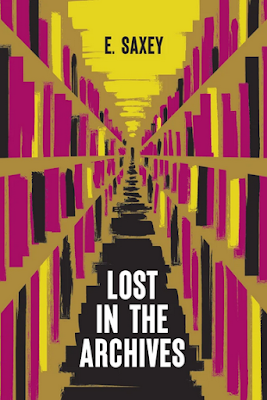 “Archives” is a surprisingly bendy term these days, currently popular as an academic theory of textual collection and collation that has staggeringly little to do with the reality of physical materials hosted in libraries, records offices, and various institutions. As an actual archivist who spends real time up to her elbows in odds and ends in various levels of process, it’s a topic I can get a bit cranky about. E. Saxey, author of Lost in the Archives, is a queer academic who clearly knows the feeling; their debut collection spans the past, present, and future, this plane and other planes, and gracefully and effortlessly bounces between soft romance, cynical academia, and both hope and pessimism for our cloudy future.
 The 2014 translation of Cixin Liu’s The Three-Body Problem by Ken Liu into English became an unexpected defining moment in the field; there is now only “before” and “after” when talking about Chinese science fiction in the Anglo world. It is significant, then, that in her introduction to Sinopticon: A Celebration of Chinese Science Fiction, that editor Xueting Christine Ni describes her experience looking for science fiction books after walking into a Xinhua bookstore (China’s biggest bookseller chain). She is surprised by the lack of genre fiction aside from Wuxia (historical fiction concerned with martial artists)*, and when she asks for Kehuan (Chinese science fiction) the clerk gestures her towards the children’s section. When Xueting protests and asks if they are really shelving material like Liu there, the clerk responds with “Oh! Why didn’t you say so before?” and leads her where the material is shelved near science education textbooks. This preliminary scene explains the value placed on Kehuan in China: still at the margins of popular culture despite undergoing a remarkable renaissance both at home, and especially, abroad. Xueting’s purpose in editing this volume is to illustrate the wide range of Chinese science fiction, translating thirteen stories that were originally published between 1991 and 2021. This thirty year review, as it were, is not presented chronologically or thematically, but rather lets each work stand against one another for the reader to enjoy. Xueting also provides, after each story, notes that discuss the author as well as context for the story’s creation and contents. Xueting also makes a point of providing gender parity in these selections, with just over half of the authors being women. The overall result is an incredibly solid, thoughtful, and exciting anthology that is genuinely one of the best I’ve read in ages.
 Katherine Addison’s The Witness for the Dead is a sequel of sorts to The Goblin Emperor (2014). The latter was one of my favorite fantasy novels from the last decade; a low fantasy with steampunk elements, it does incredibly interesting things with racing elves and goblins, while also telling a solid story of a young man’s coming-to-power and of age. The Witness for the Dead picks up shortly afterwards and stars a minor character from the previous book, Thara Celehar, as he tracks down a murderer. I’m not much of a mystery reader, but this is an effective genre mash-up that left me pleased with how smoothly all the story elements came together and wanting more books just like it. It’s also a standalone novel that will easily make sense to someone who hasn’t read Goblin.
 The Angel of the Crows is the sort of high concept story which should be ridiculous and yet totally works: Sherlock Holmes meets “war in Heaven,” or rather, its aftermath. Nineteenth century Afghanistan remains Afghanistan, but now with fallen angels and hellhounds. (The BBC Sherlock, another recent albeit problematic retelling of Sir Arthur Conan Doyle’s eponymous detective stories, similarly played with a background conflict in Afghanistan that was specifically twenty-first century.) Addison’s novel isn’t a straightforward retelling of Sherlock or Doyle, but nonetheless riffs cleverly on familiar plot beats to tell a story at a slant. Sherlock is an angel called Crow and Watson is called Doyle; neither of them are the characters that we already know so well, except for how they are.
 Rebecca Roanhorse’s novel Black Sun is an epic fantasy drawing on the pre-Columbian cultures of the Americas for its world-building, social structures, mythos, and terminology. Like other fantasies that draw on history at a slant, it makes the familiar strange and the strange familiar. It is a true masterpiece of suspense and storytelling, and is simply the best new novel I’ve read in ages. Roanhorse structures the story in shifting times, and across several characters, leading up to the Winter Solstice and a celestial convergence leading to a solar eclipse that creates the titular Black Sun. The story moves forwards, backwards, and forwards again to illuminate what various characters know and when they know it, and providing new readings for different characters. If this novel were a film we would think of it as an homage to Tarantino; in the context of this story, in which scenes are placed against quoted texts, it is more like if Frank Herbert’s Dune series had dialed the anti-imperialist message all the way up.


