J.R. Mabry, The Where, the Who & the What: A Gnostic Science Fiction Novel. Apocryphile Press, 2025. Pp. 668. ISBN 978-1-958061-92-3. $24.99 pb/$0.99 e.
Reviewed by Don Riggs

Reviewed by Storm Blakley

Lightspeed June 2024 has both sci-fi and fantasy, short stories and flash. Both sci-fi short stories offered commentary on war, while the fantasy short stories each focused on belief, and gods. The sci-fi flash stories focused on relationships, while the fantasy flash stories speak from the perspective of creatures far older and wiser than humanity.
Reviewed by Storm Blakley
 Science fiction has long been a vehicle for exploring sentience; the dizzying variety of it, exploring the most fundamental emotions and needs, placing every aspect of humanity and sentience under a microscope to see what we can learn. Clarkesworld’s February 2024 issue tackles religion and belief, addiction and alien/artificial intelligence, climate change and conflict, immortality and isolation, and everything in between.
Reviewed by Storm Blakley
 Kaleidotrope’s Autumn 2023 issue offers a wonderful collection of fantasy, sci-fi and a little horror. Each poem and story held, for me, a reflection on very fundamentally human needs and ideals, from a delightful array of differing perspectives.
This issue opens with “A Place We Used to Visit” by Bennett North. It is a time travel story, but not at all in the way I’d expected; it was wonderfully done. If we had the chance to go back, to avert a tragedy, would we? Knowing that that would mean we no longer become the person we are, would we? I think most of us would like to think so, but we can never really know until we’re in that situation. North does a wonderful job expressing the fear and confusion the protagonist feels, and how frightening that decision would truly be.
Reviewed by Gwen C. Katz
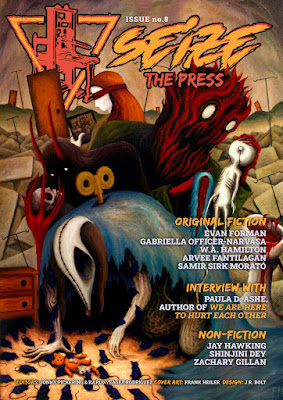 ’Tis autumn, the season of death and endings and remembering things you swore you’d get around to sooner, and that makes three good reasons for me to review the new Seize the Press. You know, the maggot sex one. But is the maggot sex any good, one must ask, or is it merely in there as a selling point for the sort of people for whom such a thing is a selling point (myself, I freely acknowledge, among them)? Let’s find out.
Reviewed by Christina De La Rocha
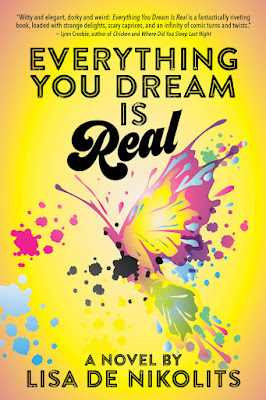 As the plot cartwheels, a motley crew of the old, the young, the lovelorn, the pregnant, the queer, the disabled, and the drug-addled overthrow the authoritarian patriarchy whose secret subterranean sex show funds its military operations. You might think what’s not to love? But, argh, for this reader possibly a few things. Your experience may differ, but I found this book frustrating rather than hilariously absurd. Everything You Dream Is Real is truly unique, has a strong voice, and is told by that cast of characters not traditionally represented in fiction, but the premise of the book changes as you move through it. Major details are lobbed in often and out of nowhere to change the direction of the plot in sort of a deus ex machina every couple of pages. I don’t often read a book and keep thinking, ‘well, geez, obviously I am a square,’ but I found this aspect of the book exhausting. I’m happy to go along for a wild ride with thrills and spills and absurdity, but I need to have some idea of the point of it at some stage well before the neatly wrapped up ending. As I’ve said, your experience may differ; I’ll wager the farm that out there in the great, big, wide world there’s a horde of rabid fans of Everything You Dream Is Real. It is that sort of book—one that either alienates you almost entirely or speaks to you so thunderously, it grabs you by the heart and doesn’t let go.
Reviewed by Don Riggs
 Vyvyan Evans is a professional linguist with an extensive interest in online technology and publishes in academic journals as well as magazines such as Psychology Today and The New Republic, so his credentials in the real-world fields of linguistics and computer tech are impressive. The Babel Apocalypse, however, is not like Neal Stephenson’s Snowcrash, although it has a somewhat similar sinister plot to gain world domination through manipulating people’s minds via language. For one thing, there is a definitely Western European cast to the characters and setting: Emyr Morgan, the protagonist, is English, though with his home in Wales, and is a James Bond-007-type of secret agent, a commander in Europol, who has relationships with various highly placed women, in which he is not always completely in control. His house is in the Netherlands, in a fishing village called Scheveningen, the name of which was used as a Shibboleth to detect Germans impersonating Dutch nationals at the beginning of World War II. This is not mentioned in the novel, although it might be a very esoteric Easter Egg.
Reviewed by Storm Blakley
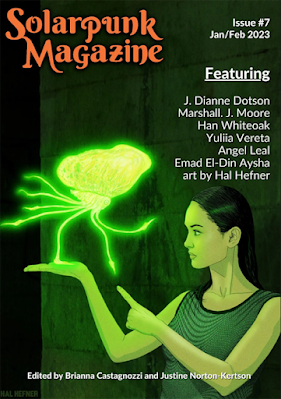 Solarpunk Magazine describes itself as a “bimonthly online publication of radically hopeful and optimistic science fiction and fantasy.” In this issue, I found a recurring theme of family, solidarity, and what we owe one another through tales of helping and supporting one another, across a great variety of worlds and times.
Reviewed by Storm Blakley
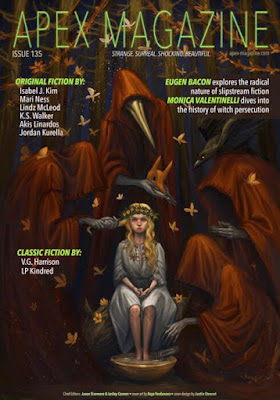 Apex Magazine’s January issue was a collection that made me think of bargains and agreements, and how those can change our perspectives on the things that really matter. Those bargains can be dangerous things, especially when made with powerful beings and magic. Whether we knowingly sign them or not, the consequences are inevitable; some bring about redemption, while others are simply dangerous.
Reviewed by M.L. Clark
 Military sci-fi comes in many moral flavours. Anna Schroeder’s Archer 887 is a highly conservative variant, as illustrated in its treatment of empire, military service, aliens as enemies, righteous torture, gender relations, and the core romance. Action forward, it’s written at an engaging pace with realistic battle sequences, and has a good sense of dialogue, so for folks looking for a more traditional SF read, this series opener promises a coherent and compelling adventure.
Reviewed by Jason Kahler
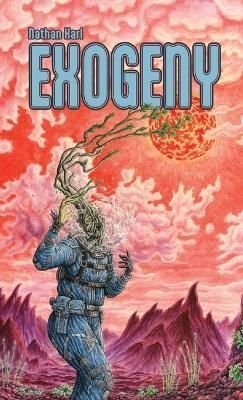 I’ve been reading DC’s current Poison Ivy mini-series, which is excellent. The main thrust of the story is that Ivy, to one degree or another, is becoming a plant monster and is making other people into plant monsters or moss or mulch or trees or what have you. I also read a lot of Jeff VanderMeer; his stories often have strange new hybrids of plants and animals folded into people. The bottom line is—I’m not sure if we’re in a particular stage of sci-fi/horror that’s focused on this vegetable type of body transformation, or if it’s just my current reading predilections. An argument could be made that we’re seeing a response to both the pandemic and the climate crisis; nature is taking things back. That’s not new, but the stories I’m seeing are just much gooier than their predecessors. Microscopic becomes macro in a bulge of puss and spittle. Good stuff.
Reviewed by Christina De La Rocha
 Apex Magazine 2021: The Companion Anthology serves up 48 stories originally published in Apex Magazine in issues 121–128, representing the year the publication bounced back from a brief hiatus. Buying a copy, in either paperback or digital form, is a great way to support an award-winning speculative fiction magazine whose issues are otherwise free to read at the magazine’s website. On the upside, the stories are of generally high quality and come from authors from a variety of places around the world. One entire issue included in the anthology was devoted to Indigenous authors telling speculative fiction stories with Indigenous protagonists—a definite breath of fresh air. But, reader, I warn you, at 544 pages (or 626 if you include front and back matter), the anthology is a long slog through darkness. It's definitely not an anthology built for binge-reading.
Reviewed by Storm Blakley
 Strange Horizons’ November issues have a lot to say, and in them, I saw a reflection of much happening in the world today, from the climate crisis to the digital world, monsters and magic and far-away planets. Stories and poems about communities standing together, of breaking free of what chains us, of creating a better world for those to come (including ourselves); these issues really resonated with me.
Reviewed by Jason Kahler
 I am acutely aware that I approach every book I read weighed-down by the baggage of my history. That load was particularly burdensome as I read the excellent Barzakh: The Land In-Between by Moussa Ould Ebnou. My exposure to African literature is woefully inadequate, so I can’t place this book anywhere within that tradition. I can’t tell you how it stacks up against contemporary African literature, or the African literature of the past. I can tell that my unfamiliarity with Africa as a literary tradition and as a geographic region heightened the sense of strangeness and other-ness I felt while reading. In many ways, that actually impacted my experience with this novel for the better. Readers who are more familiar with these traditions are sure to appreciate what they find in this story.
Reviewed by Storm Blakley
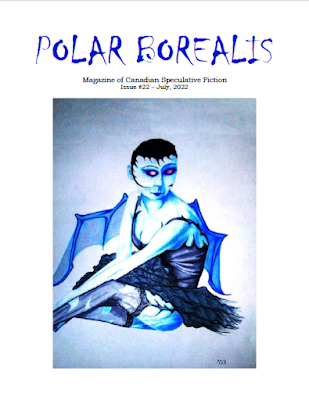 The 22nd issue of Polar Borealis, a publication I was until now unfamiliar with, opens with an editorial, musing on how far this Aurora-award winning publication has come in the six-plus years since its inception. Read all over the world, nominated for and winning awards, a paying market for Canadian writers and artists, while still acknowledging how challenging the industry can be. Overall, it’s cheerful and optimistic; hopeful, with an eye on the future.
Reviewed by Christina De La Rocha
 Fireside Magazine was—and, yes, I must sadly say was—a online publisher of short stories, poems, and novels. Founded in 2012, it’s had a respectable 10-year run, at first based on crowdfunding, then on subscriptions. But now Fireside’s operations are now winding down. Issue 103 (Summer 2022) represents the magazine’s final offering of stories to the world.

Reviewed by Jason Kahler
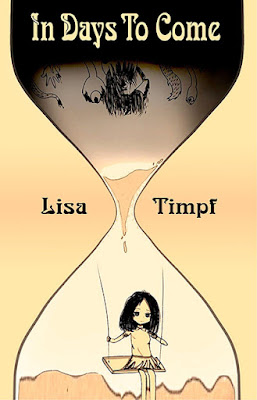 A reader’s response to In Days to Come, Lisa Timpf’s slim collection of poetry, will depend on his or her attitude toward a few things:
I love poetry, and I love science fiction, so I’m all for bringing the two together. Overall, readers will find plenty to enjoy in Timpf’s book. There are enough poetic moments, what noted poetry critic Clive James called “little low heavens,” to make readers feel like the time they share with the book was time well-spent. Casual or new poetry readers will enjoy finding poetry doing things they didn’t know poetry could do. More critical poetry fans will appreciate Timpf’s book, too, though they may be able to identify some places where the book’s weakest elements don’t live up to the promise of its strongest.
Reviewed by Christina De La Rocha
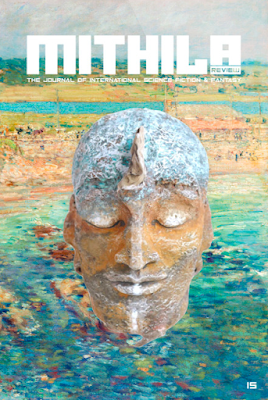 Mithila Review, founded in 2015, is a science fiction and fantasy magazine based in India but international in scope. This is a promise Mithila absolutely delivers on, for not only does it contain stories from all over, the magazine’s own gaze looks firmly out from its non-Western corner of the world and this is a wonderful thing. About half of the stories in the magazine are told from an Indian perspective and it’s a delight to read the stories that look out at the future and the effects of global events through the eyes, hearts, and experiences of people and places many of us are not used to inhabiting in fiction, given the Anglosphere’s publishing industry’s gatekeeping in favor of white, Western authors. It helps that the stories, articles, and poems in Mithila Review lean into the literary and are written handsomely and at times in an English that is perfect yet non-Western in tone. This deepens the flavor of these works and befits a magazine that is named for a distinct geographic, cultural, and linguistic region with ancient roots that is now split by the border between India and Nepal and grappling with attempts at political control and cultural and linguistic assimilation from two different countries.
Reviewed by M.L. Clark
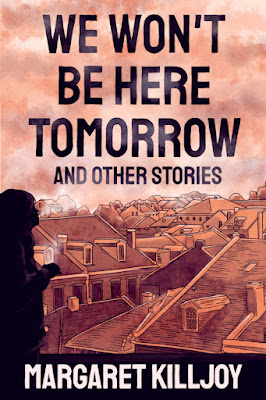 In an episode of her podcast Live Like the World Is Dying, Margaret Killjoy reframes the concept of eco-nihilism as something that creates room for personal agency amid the inevitability of climate change. If we embrace the fact that climate change is already here, and that we cannot prevent all the horrors ahead, does this not lighten our burden as individuals? Are we not then freed up to focus on what we can do and save, instead of trying to do and save it all?

