
Brandon Applegate (ed.), It Was All a Dream: An Anthology of Bad Horror Tropes Done Right. Hungry Shadow Press, 2020. Pp. 338. ISBN 979-8-986920-20-7. $16.98.
Reviewed by Gwen C. Katz
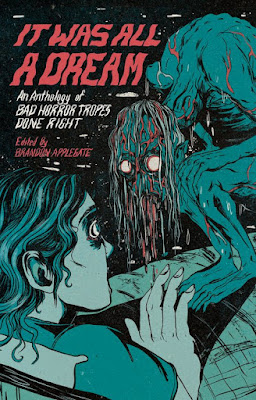 When Hungry Shadow Press announced It Was All a Dream, I was immediately curious and a bit puzzled. The foremost question in my mind: What does it mean to do a trope right? There are many possible answers to this question, and It Was All a Dream showcases all of them. The stories in this anthology fall into four categories: Parodies, metanarratives, inversions, and stories that are played straight. Quite an assortment!


 I am acutely aware that I approach every book I read weighed-down by the baggage of my history. That load was particularly burdensome as I read the excellent Barzakh: The Land In-Between by Moussa Ould Ebnou. My exposure to African literature is woefully inadequate, so I can’t place this book anywhere within that tradition. I can’t tell you how it stacks up against contemporary African literature, or the African literature of the past. I can tell that my unfamiliarity with Africa as a literary tradition and as a geographic region heightened the sense of strangeness and other-ness I felt while reading. In many ways, that actually impacted my experience with this novel for the better. Readers who are more familiar with these traditions are sure to appreciate what they find in this story.
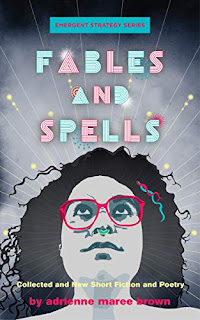 When I first encountered the work of adrienne marie brown, it was through her book, Emergent Strategy. That book showed me a gap in my existence and began the process of filling it in. brown introduced to me the concept of moving through systems in nonlinear and creative ways with whole minds, bodies, and communities. She embraces this perspective again in her new release, Fables and Spells: Collected and New Short Fiction and Poetry. The book is long and complex, ever-shifting like an octopus exploring the environment. It challenges the reader to find a place of relaxed alertness while acknowledging the pain of both change and stagnancy. brown is one of the few writers who makes the reader inescapably aware of the body—not just the reader’s body, but all bodies in space and time and politics. Her work and activism are tender and confident like a practiced lover, alive and breathing.
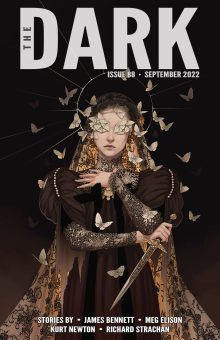 The Dark is a monthly online zine famous for both its excellent dark fiction output and its stringent and remarkably rapid rejections—indeed, while I was working on this review a tweet went somewhat viral from an author irate that they had rejected his manuscript three minutes after he submitted it. It’s a leading venue for modern horror fiction that favors atmosphere over gore, and provides a home both for the big names of the genre and relative newcomers. All four stories in the September 2022 issue are strong entries. Stylistically, they share a clear, realist voice, with rather straightforward narratives. There are flashbacks, and the smartly-paced unveiling of details necessary for the genre, but none are overly experimental or knotty in approach.
 The story begins in a gambling joint in Goetia, a mining town in the mountains run by a privileged elite. It’s an unholy place and Celeste, a dealer at the card tables of the Eden, “Perdition Street’s premiere gambling and drinking establishment,” has seen her share of squalor, degradation, and exploitation and there’s the obligatory saloon-fight in the first ten pages. But when her sister Mariel, a singer at the Eden, is arrested for a particularly nasty murder, Celeste is forced to embark upon a quest to prove her sister’s innocence. In doing so, she sees even more of the town’s darker side than she ever thought existed.
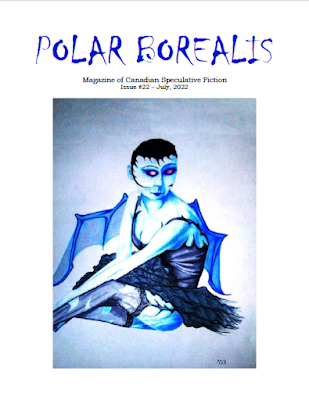 The 22nd issue of Polar Borealis, a publication I was until now unfamiliar with, opens with an editorial, musing on how far this Aurora-award winning publication has come in the six-plus years since its inception. Read all over the world, nominated for and winning awards, a paying market for Canadian writers and artists, while still acknowledging how challenging the industry can be. Overall, it’s cheerful and optimistic; hopeful, with an eye on the future.
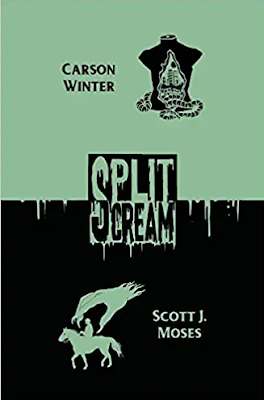 Novelettes and novellas, the red-headed stepchildren of the book world. Too long to place in a magazine and uneconomical to publish on their own, they languish on hard drives, making an occasional appearance as the flagship piece in a single-author collection, but otherwise neglected. Which is a shame, because they’re my fictional first love. About the same length as a TV episode or a graphic novel, they’re a lean, focused form of storytelling, just the right length to fully explore a single arc without needing to detour into subplots. They’re a convenient airport-or-dentist size and they’re nice for those of us who have a bad track record of finishing full-length novels.
 If you tried to reverse engineer the contents of Issue 363 of the literary adventure fantasy online magazine Beneath Ceaseless Skies, you might find a writing prompt in your hand: tell a tale of thwarted immortality. That probably isn’t actually the origin of the two new stories published in the issue, of course. It’s more likely that an editor decided that these two new stories belonged together because of that similarity at their core. Either way, what’s interesting is that these two new stories taking thwarted immortality as a premise are nothing like each other.
 Fireside Magazine was—and, yes, I must sadly say was—a online publisher of short stories, poems, and novels. Founded in 2012, it’s had a respectable 10-year run, at first based on crowdfunding, then on subscriptions. But now Fireside’s operations are now winding down. Issue 103 (Summer 2022) represents the magazine’s final offering of stories to the world.
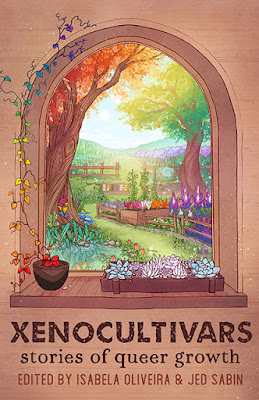 Confession time: I wanted to submit to this one, but something came up, where “something” is “my own laziness.” But, having read it, I’m now glad I didn’t submit, because I probably would have dragged down the average. When Speculatively Queer launched last year with the triumphant It Gets Even Better: Stories of Queer Possibility, it stepped into an under-served market: Full-length queer SFF short stories. Consequently, a lot of us have been keeping an eye on it. Xenocultivars, its sophomore publication, is a very strong follow-up, and a sign that Speculatively Queer may be a formidable new contender.
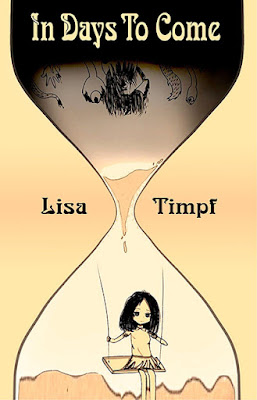 A reader’s response to In Days to Come, Lisa Timpf’s slim collection of poetry, will depend on his or her attitude toward a few things: