Monday, March 10, 2014

Duncan & Kelso (edd.), Caledonia Dreamin' (2013)

Hal Duncan and Chris Kelso (edd.), Caledonia Dreamin’: Strange fiction of Scottish descent. Eibonvale Press, 2013. Pp. 274. ISBN 978-1-90-81253-0-9. £9.50.

Reviewed by Margrét Helgadóttir

The anthology, edited by Hal Duncan and Chris Kelso and published by Eibonvale Press in December 2013, is a well-crafted collection of seventeen stories that all have been written on the basis of a single Scottish word. The Scottish language and culture is the dominant frame of this book, but it has a broad range of themes and plots and travel across all the speculative genres. The characters in these stories deal with issues like a sudden urge to bathe in the muddy water, the complaining dead mother, the hungry newborn child, the yearning for knowledge, the fear of turning into an animal, a longing for the homeland, or not wanting to go home but to keep wandering. These tales are weird, terrifying, dark, beautiful, disturbing and funny. It was quite a thought-provoking read. Some of these stories are amongst the best stories I have read for quite a while and I recommend the book for not only the lovers of Scotland, the Scots language or linguistics in general, but for all fans of the weird and unexplainable, or people who enjoys plain good writing.

Saturday, March 08, 2014

Biddle, Atheist’s Prayer (2014)

Amy R. Biddle, The Atheist’s Prayer. Perfect Edge Books, 2014. Pp. 234. ISBN 978-1-78099-582-3. $16.95/£9.99.

Reviewed by Kate Onyett

In a vibrant and gripping first novel, Biddle has produced a strong satirical critique of human behaviour; specifically the behaviour that surrounds belief and what we do to sustain it. In a tale of ordinary folk in a dingy, Southern-State American town from very different backgrounds, their lives intertwine in a series of events culminating in near-tragedy. Lizzie is a single mother of Kevin, a somewhat precociously curious little seven-year old. Kevin makes friends at Sunday school with eleven-year-old Luna, whose psychologically broken mother, Heather, is part of a fairy-believing cult. Buying hallucinogenic mushrooms from Candy, a tattooed stripper, Heather draws the children into a dangerous ritual, from which only Candy and Hank, a barroom rat, can save them.

Saturday, March 01, 2014

Wimpress, Weeks in Naviras (2013)

Chris Wimpress, Weeks in Naviras. Self-published, 2013. Pp. 255. ISBN 978-1-31079-670-8. $2.99.

Reviewed by Paul Wilks

Ellie Weeks, the main protagonist in Chris Wimpress’ Weeks in Naviras is killed in a terrorist attack. However, shortly afterwards she wakes to find herself in a unique afterlife based on her experiences of Naviras, a quiet Portuguese fishing village which she had fallen in love with many years before. The story is split into two narratives which generally alternate with each chapter. It begins with Ellie’s afterlife experience but then also provides the background of her life and how she came to be killed. The book is well-structured with this evocative trick that keeps you reading, even in the more pedestrian sections of the narrative where you’re not quite sure what the story is driving towards.

Sunday, February 23, 2014

Smith, Purified (2014)

Brian Robert Smith, Purified. 323 Books, 2014. Pp. 320. ISBN 978-0-99204-830-3. $2.99.

Reviewed by Kate Onyett

In a small-ish mid-western town, two body-snatchers are at work in a funeral home, removing the late lamented wife of a local cop—but she is considerably less dead than previously supposed. In the middle of no-where, Mason Bushing escapes from a secret installation, revived and bouncing after he thought he was dead. A scientific genius has discovered a way to cheat death, but Mason will not willingly become just any old medical guinea-pig, and with the desire to rekindle his old life anew, he sets off across the corn fields…

Smith has aimed for action, humanity and draws out (whether he realises it or not) comparisons to the modern monster parable, creating a Frankenstein story for modern medical technology. Smith appears to touch on questions on human existence, such as; what is identity? When our living life is taken away, who are we? How do we live? His protagonist, Mason, is our focus of attention, the Frankenstein Creature with a name and a past and enough machismo to take to his fists to solve some sticky situations. Unfortunately, Smith’s skill does not match the bravado and breadth of his project. The book has great potential, but has been ‘sent out into this breathing world, scarce half made up’, as the Poet might say. It’s a shame; there is a lot here to tickle the imagination.

Thursday, February 13, 2014

Whitmore, Bank of the Dead (2013)

Steve Whitmore, Bank of the Dead. Abysswinksback Books, 2013. Pp. 24. ASIN B00HDOD7VK. $1.27.

Reviewed by Kate Onyett

Whitmore is a funny man. No, really, he is. Funny that is daft, yet surprisingly literate at the same time. Specialising in the lightest, shallowest of nonsense stuff, he prefers his fantasies to take a large dollop of comic-book caper, mash it up with semi-mythological tropes and serve on a bed of contemporary contiguousness, sprinkled with a garnish of outrageous wordage. This time he is taking a swipe at banks, greed, and the power of the people. Well, the dead ones, anyway.

Friday, February 07, 2014

Ellis/Thomas, Queers Dig Time Lords (2013)

Sigrid Ellis and Michael Damian Thomas (eds), Queers Dig Time Lords: A Celebration of Doctor Who by the LGBTQ Fans Who Love It. Mad Norwegian Press, 2013. Pp. 240. ISBN 978-1-9352341-4-2. $17.95.

Reviewed by Tracie Welser

Queers Dig Time Lords, edited by Sigrid Ellis and Michael Damian Thomas, was released last summer by Mad Norwegian Press. This small press is the same publisher behind the Hugo Award-winning Chicks Dig Time Lords, as well as Chicks Unravel Time and a slew of other Doctor Who and Whedonverse-related unofficial guides and commentary.

I, for one, enjoy critical work about pop culture. Works like What Would Buffy Do? deploy pop culture as a strategy for teaching philosophy and a provide a fandom-specific lens for examining society. We can geek out while turning a critical eye to our favorite works. Books of this sort are stimulating reading but can be a little didactic. But this book, like Chicks Dig Time Lords, is about fandom itself, and does a service to fandom. It’s a bit like being welcomed to a conversation in which a multiplicity of voices within fandom are asked why this universe and its occupants are so meaningful to so many.

Wednesday, February 05, 2014

Connell, Miss Homicide Plays the Flute (2013)

Brendan Connell, Miss Homicide Plays the Flute. Eibonvale Press, 2013. Pp. 176. ISBN 978-1-90-81252-2-4. £8.99.

Reviewed by Djibril al-Ayad

This strange little title is the eighth book published by prolific and acclaimed author Brendan Connell, in a typically high quality and quirkily packaged edition by Eibonvale Press. To all intents and purposes this is a crime novel, featuring a sociopathic assassin, art thefts, family feuds and sexual transgression, but it is so full of experimental features, nonlinear digressions, dreamlike descriptions and rambling, pedantic detail that I suspect it rather thinks of itself as "literary" in genre. The protagonist is a female assassin with expensive tastes, an obsession with music, a master of disguise and poisons, a seductress and cold-hearted killer, pretty much your classic femme fatale. Nevertheless Connell manages to subvert pretty much every cliché in the book (and for such a small book, he sure does have a lot of them to subvert). Sometimes hard to read, especially when lists of classical citations and cultural references are not even disguised in the form of running prose, this novel is almost painfully self-aware, but nevertheless, and despite unappealing characters, keeps the pages turning to see how the story ends. It's a complicated, highly crafted book, not without flaws, but also not without that spark of genius that dares to take this sort of a risk.

Monday, February 03, 2014

Beatty, Heron Fleet (2013)

Paul Beatty, Heron Fleet. Matador Press, 2013. Pp. 251. ISBN 978-1-78088-443-1. ₤8.99 print/£3.99 ebook.

Reviewed by Nino Cipri

In speculative fiction, the post-apocalyptic novel is probably a direct descendent of the utopian novel. The latter focus on societies that are somehow free from the influence of the outside world, while the former exist in the tabula rasa of a ruined world. In a globalized world, a planetary cataclysm is easier to imagine than an undiscovered island culture without radio, wifi, an intrusive anthropologist, or a White Savior, a la Kevin Costner in Dances With Wolves and all its derivatives. Post-apocalyptic stories inherited the same problems that infested utopian allegories and still plague dystopian novels: their moral certitude, and their lack of ambiguity for example. It’s always easy to see where the author’s prejudices and presumptions lie.

Saturday, February 01, 2014

Fox et al., Journeys in the Winterlands (2013)

Dylan Fox, C. Allegra Hawksmoor and John Reppion, Journeys in the Winterlands. Vagrants Among Ruins, 2013. Pp. 52. ISBN 978-0-9574872-0-8. £2.00 (digital)/£4.00 (print).

Reviewed by Su J. Sokol

Journeys in the Winterlands are three connected short stories that take place in a post-steampunk wintery apocalypse, or, as it’s been described, a “snowpocalypse.” Living in Montréal and in the middle of an intense cold snap, I couldn’t resist reading and reviewing such a book. I was not disappointed. Although the book felt a little incomplete, and at times and seemed to be missing connections, it is amazingly rich in world-building, atmosphere and character development. This is a particularly impressive achievement for a book of its brevity. Another challenge for this writing project is the fact that it’s a collaboration between three different writers. As co-author Dylan Fox remarked, the aim was to “make something greater than the sum of us as individuals.” The question is whether they succeeded, and if so, what that something is.

Monday, January 20, 2014

Stott, Past Un-Earthed (2012)

Jeff Stott, Past Un-Earthed. Self-published, 2012. Pp. 300. ISBN 978-1-3017-9957-2. $2.99.

Reviewed by Kate Onyett

It takes a while for the penny to drop, but once it does, it’s a doozy. This is the story of two young people who met, fell in love and then had to face the consequences of their choices. On a relatively simple premise, Stott has built a moving and highly plausible science-fictional romance. Joshua is an Earth lad with stress-induced powers of strength and recuperation. Orphaned at fourteen and subsequently emotionally shut off from the world, he falls for beautiful Mari, and starts a wonderful romance, only to discover she has secrets, one of which is a pregnancy he had no hand in. Mari—or rather, Lara—is a naive girl from the planet Lateo, one of an advanced race, among which a devastating disease among the planet’s children is being blamed on exposure to Earth. In a high-powered political existence, Lara has her black-and-white preconceptions about politics and her father’s moral purity ripped away. Forced into marriage with the opposition leader, she flees to Earth. Once there, she strives to find the one member of the original exploration mission who stayed and fell in love with a ‘mere’ human. Instead she finds instead his reclusive son, and comes to realise that the most pervasive of ‘infections’ is this thing called love.

Saturday, January 18, 2014

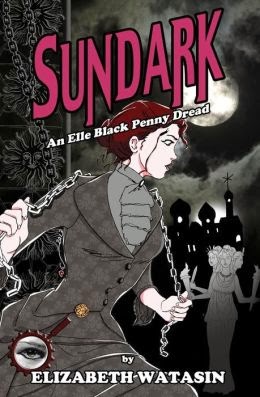
Watasin, Sundark (2013)

Elizabeth Watasin, Sundark: An Elle Black Penny Dread. A-Girl Studio, 2013. Pp. 184. ISBN 978-1-9366-2205-4. $11.99.

Reviewed by Djibril al-Ayad

Contributing to a proud tradition of self-published steampunk serials that are simultaneously genre-bending and hark back to the most staid media of the Victorian period, Sundark is an odd little novel that manages to be charming and unsettling in equal measure. Watasin herself evokes the "penny dread[ful]", the cheap, short, popular and disposable stories that helped bring literature down from its preserve of the moneyed and educated classes to a wider audience. An odd mix of progressive and traditional elements, both stylistically and ethically speaking, and an uneven, sometimes predictable plot, means I can't unequivocally praise this book. Engaging characters and some lovely scene-setting do make this an enjoyable read, however, and the author's prolific output promises much more of the same to follow.

Wednesday, January 15, 2014

Turner, How to be Dead (2013)

Dave Turner, How to be Dead. Aim For The Head Books, 2013. Pp. 75. ASIN B00H17V7OS. £0.99/ $1.63.

Reviewed by Kate Onyett

Dave is not an obvious hero. He’s a bit of an apathetic worker; just marking time perma-temping at a big business. He knows how to handle the pushy behaviour of his manager, but goes to pieces over Melanie—the girl of his dreams and office hottie. Oh, and he can see ghosts. While saving Melanie’s life on a Halloween night out, he is hit by a car and has a near-Death experience. Literally. He and Death go to a pub and Death offers him a new career opportunity. Revived, and with a greater zest for life (primarily due to the life-flashing-before-his-eyes thing being just a sequence of mundane nothingness he wants to seriously improve), Dave decides to see what Death was on about. However, his heroics have made a hit at work, and progression into the ranks of upper management, with his own office and no clue as to what he should be doing beckons Dave with golden temptation. Will he make a deal with Death and agree to help lay tormented undead to rest? Will he strike lucky with Melanie? Will he ever get to grips with his computer?