Monday, January 20, 2014

Stott, Past Un-Earthed (2012)

Jeff Stott, Past Un-Earthed. Self-published, 2012. Pp. 300. ISBN 978-1-3017-9957-2. $2.99.

Reviewed by Kate Onyett

It takes a while for the penny to drop, but once it does, it’s a doozy. This is the story of two young people who met, fell in love and then had to face the consequences of their choices. On a relatively simple premise, Stott has built a moving and highly plausible science-fictional romance. Joshua is an Earth lad with stress-induced powers of strength and recuperation. Orphaned at fourteen and subsequently emotionally shut off from the world, he falls for beautiful Mari, and starts a wonderful romance, only to discover she has secrets, one of which is a pregnancy he had no hand in. Mari—or rather, Lara—is a naive girl from the planet Lateo, one of an advanced race, among which a devastating disease among the planet’s children is being blamed on exposure to Earth. In a high-powered political existence, Lara has her black-and-white preconceptions about politics and her father’s moral purity ripped away. Forced into marriage with the opposition leader, she flees to Earth. Once there, she strives to find the one member of the original exploration mission who stayed and fell in love with a ‘mere’ human. Instead she finds instead his reclusive son, and comes to realise that the most pervasive of ‘infections’ is this thing called love.

Saturday, January 18, 2014

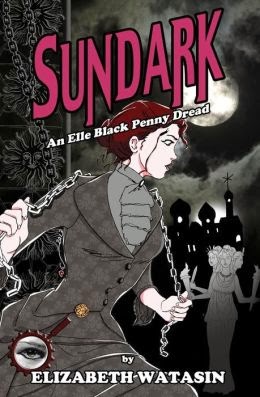
Watasin, Sundark (2013)

Elizabeth Watasin, Sundark: An Elle Black Penny Dread. A-Girl Studio, 2013. Pp. 184. ISBN 978-1-9366-2205-4. $11.99.

Reviewed by Djibril al-Ayad

Contributing to a proud tradition of self-published steampunk serials that are simultaneously genre-bending and hark back to the most staid media of the Victorian period, Sundark is an odd little novel that manages to be charming and unsettling in equal measure. Watasin herself evokes the "penny dread[ful]", the cheap, short, popular and disposable stories that helped bring literature down from its preserve of the moneyed and educated classes to a wider audience. An odd mix of progressive and traditional elements, both stylistically and ethically speaking, and an uneven, sometimes predictable plot, means I can't unequivocally praise this book. Engaging characters and some lovely scene-setting do make this an enjoyable read, however, and the author's prolific output promises much more of the same to follow.

Wednesday, January 15, 2014

Turner, How to be Dead (2013)

Dave Turner, How to be Dead. Aim For The Head Books, 2013. Pp. 75. ASIN B00H17V7OS. £0.99/ $1.63.

Reviewed by Kate Onyett

Dave is not an obvious hero. He’s a bit of an apathetic worker; just marking time perma-temping at a big business. He knows how to handle the pushy behaviour of his manager, but goes to pieces over Melanie—the girl of his dreams and office hottie. Oh, and he can see ghosts. While saving Melanie’s life on a Halloween night out, he is hit by a car and has a near-Death experience. Literally. He and Death go to a pub and Death offers him a new career opportunity. Revived, and with a greater zest for life (primarily due to the life-flashing-before-his-eyes thing being just a sequence of mundane nothingness he wants to seriously improve), Dave decides to see what Death was on about. However, his heroics have made a hit at work, and progression into the ranks of upper management, with his own office and no clue as to what he should be doing beckons Dave with golden temptation. Will he make a deal with Death and agree to help lay tormented undead to rest? Will he strike lucky with Melanie? Will he ever get to grips with his computer?

Sunday, January 12, 2014

Hensley, Filipino Vampire (2011)

Raymund Hensley, Filipino Vampire. Self-published, 2011. Pp. 74. ISBN 978-1-4581-2012-0. $0.99.

Reviewed by Kate Onyett

I had no idea what to expect with this one. The cover suggests a dark, moody piece; gothic with a ‘k’, all dripping candles and mood dry ice. Instead Hensley’s social gothic explodes onto the screen with amazing vivacity and verve. Commencing as a picture of an abusive childhood at the hands of a semi-psychotic, single, drunken mother, the story, told from the viewpoint of a teenage girl, never named, swerves left at the traffic lights into a full-on assault of horror, drenched in gore and astonishing imagery, sufficed with the shriek of the aswang; a Philippine mythological beast that feasts on flesh and blood, a flying torso that strikes at night on children. This is the vampire of Filipino cinema, and aswang films are a popular horror staple.

Tuesday, December 10, 2013

Weird Tales #360/361 (2013)

Weird Tales Magazine, issue #360 (2013): Old Ones. Pp. 113. and issue #361 (2013): Fairy Tales. Pp. 113. Each $9.99 print/$7.99 e-book bundle.

Reviewed by Nino Cipri

I admit to being a sporadic consumer of news, particularly when it comes to publishing, even more particularly when it comes to the SF/F publishing world. Every few months, it seems, another idiot straps a load of bullshit and dynamite to their chest, determined to have their say and blow up the internet in the process. As author Genevieve Valentine recently put it on Twitter, “Oh, the SF community, where the Venn diagram of catching up on news and wanting to light things on fire is a circle.”

It’s important to confront the idiocy, the prejudice, the racism and the misogyny and bullshit. Hats off to the folks that manage to swim through those swamps without getting bogged down or eaten by crocodiles. But for the sake of my own sanity, I try not to get consumed by it. Maybe this explains why I was genuinely excited when offered a chance to review the two new issues of Weird Tales. If I’d been paying attention, I would have known that the magazine had recently gone to hell in a startlingly flashy way.

Wednesday, November 13, 2013

Alexander, Past Present Future (2013)

N.J. Alexander, Past Present Future: A social network thriller. Roundfire Books, 2013. Pp. 309. ISBN 978-1-846949-70-8. $20.95 / £11.99.

Reviewed by Rochelle Spencer

N.J. Alexander’s “social media thriller,” Past Present Future is both fascinating and frustrating. What fascinates: set in the UK, in 2008, against the backdrop of the beginnings of a global recession and the rise of Facebook and Twitter, Alexander’s novel reveals our worst fears about the economy and technology. What frustrates: most of the book’s most thrilling moments occur online, as the protagonist, Nicole, reads the Facebook messages of Anthony Hope, a moderately successful American singer and former co-worker who may—or may not—be stalking her. Alexander has a talent for blending classic surreal imagery with an exploration of the dangers of modern technology, and readers will enjoy how many of Anthony and Nicole’s Facebook posts reference Lewis Carroll’s Alice in Wonderland. Still, despite this psychological tension, I wanted to see more of these characters, particularly Nicole, in real life. In other words, while I love that this book pays so much attention to our virtual lives, the problem with having few in-person moments is that it becomes difficult to understand Nicole and Anthony’s characters. Readers will recognize, for instance, that we present a more glamorous image of our online lives, that our Facebook pages omit or downplay moments that show us as less than clever, witty, or strong. So, every time Anthony posts to his Facebook page, it’s hard to figure out if he’s sending Nicole a veiled message (this is her belief) or if it’s just an innocuous coincidence. And, without real-life action, the reader views Nicole and Anthony as online strangers, not as actual friends we care about, and it becomes hard to understand or sympathize with either of them.

Saturday, November 09, 2013

Savile & Parish-Whittaker, Leviathans in the Clouds (2013)

Steven Savile & David Parish-Whittaker, Leviathans in the Clouds. Untreed Reads, 2013. Pp. 90. ISBN 978-1-6118756-7-6. $2.99.

Reviewed by Kate Onyett

And so it is ho! for adventure in the skies and on the boggy wetlands of Venus. Space 1889: the small, but cheerfully championed, series of novellas based on the premise of a classic role-playing game have entered their second season, continuing the cross-solar system exploits of Nathanial and Annabelle. Fundamentally a sequence of steam-punk escapades in outer space, told with the enthusiasm of Boys’ Own serials, the stories are fun escapism for anyone who likes a cheerfully outlandish alternate history premise, served with dollops of action.

Sunday, October 27, 2013

Lewis (ed.), Horror Without Victims (2013)

D.F. Lewis (ed.), Horror Without Victims. Megazanthus Press, 2013. ISBN 978-1-291-45143-6. $14.64.

Reviewed by Rachel Verkade

Can you truly have horror without there being a victim?

It’s an interesting question, and one that comes down to the very definition of horror as a genre. As my husband put it, does horror naturally have to consist of bad things happening to people? I couldn’t think of a single example of horror that did not consist of bad things happening to people, even if they were not physically harmed. Surely even if someone’s wounds are purely emotional/psychological, they still count as a victim? Or, for that matter, what if the horror happens to others, only vaguely affecting our characters? At what point does a character become important or developed enough for their suffering to qualify them to be victims?

Saturday, September 28, 2013

Larson, In Retrospect (2013)

Ellen Larson, In Retrospect. Five Star Publishing, 2013. ISBN 978-1-4328-2733-5. $25.95.

Reviewed by Su J. Sokol

The publisher identifies Ellen Larson’s novel In Retrospect as a dystopian murder mystery, but it could also be described it as a post-apocalyptic, post-colonial time travel whodunit. Living up to the demands of each of these sub-genres is an ambitious undertaking. Its success or failure lies in how the story, with all of its themes and elements, does or does not hold together. Efficient storytelling and strong (if occasionally stock) characters make this a very promising start, but the world-building is sometimes lacking in the details. As a novel this ultimately satisfies, despite some flaws.

Saturday, September 21, 2013

Whiteley, Witchcraft in the Harem (2013)

Aliya Whiteley, Witchcraft in the Harem. Dog Horn Publishing, 2013. Pp. 132. ISBN 978-1-9071334-0-4. $12.61.

Reviewed by Margrét Helgadóttir

Witchcraft in the Harem, by the UK-based author Aliya Whiteley, was published by Dog Horn Publishing earlier this year. This is a well-crafted collection of seventeen stories that were originally published in different magazines and anthologies between 2003 and 2012. Though one of the dominant themes is motherhood, the book has a broad range of themes and plots, and travels across all the speculative genres. The majority of the main characters in the stories are women and they deal with issues like the awful husband, the boyfriend, the unwanted child, the yearn for a child, the boss, the mother, the miserable life as housewife and so on. It might sound trivial, but these are some of the best stories I have read for quite a while. These tales are weird, terrifying, beautiful, disturbing and funny. They are exceptionally well written and very entertaining.

Wednesday, September 18, 2013

Witney, Zombies: They're Not All Brain-Eaters (2013)

Alex Witney, Zombies: They're Not All Brain-Eaters. DMPP, 2013. Pp. 170. ISBN 978-1-4839527-6-5. £2.99 (kindle)/£6.99 (paperback).

Reviewed by Kate Onyett

This is a novel that relies very much on the ground-breaking themes of previous popular self-referential modern fantasy and sci-fi, as well as notable cult favourites, and it knows it. With direct shout-outs to zombie films, Beetlejuice, The Hitchhiker’s Guide and even Dr Who (I think), among others, this is a ‘post modern’ take on zombies. Ho, ho, ho, let’s make a zombie-human buddy book, eh? The reader is encouraged to pick up the idea and run with it. To do him credit, Witney does do this with a cheeky wide-boy charm that makes for a fun, if uneven, read.

Monday, September 16, 2013

Damask, Wolf at the Door (2011)

J. Damask, Wolf at the Door. Lyrical Press, 2011. Pp. 125. ISBN 978-1-6165025-6-0. $7.99 pb/$4.14 e-book.

Reviewed by Kate Onyett

Written by a native Singaporean, and set there, this novel is crafted with a deal of clear personal investment. Damask knows her city, and her customs, and celebrates them with a casual elegance in the details of her writing. She also invests a set of beliefs that will be alien to many of her readers with a sense of supernatural naturalism that makes the superstitions and rituals of the East seem very necessary, and furthermore, reciprocated, by the weird and wonderful beyond human scope.