J.R. Mabry, The Where, the Who & the What: A Gnostic Science Fiction Novel. Apocryphile Press, 2025. Pp. 668. ISBN 978-1-958061-92-3. $24.99 pb/$0.99 e.
Reviewed by Don Riggs

Reviewed by Storm Blakley

Lightspeed June 2024 has both sci-fi and fantasy, short stories and flash. Both sci-fi short stories offered commentary on war, while the fantasy short stories each focused on belief, and gods. The sci-fi flash stories focused on relationships, while the fantasy flash stories speak from the perspective of creatures far older and wiser than humanity.
Reviewed by Lisa Timpf
 anOther Mythology is a collection of horror prose-poetry re-imagining myths from a queer perspective, penned by Maxwell I. Gold, a five-time Rhysling Award nominee, and twice Pushcart nominated Jewish American author of prose poetry and short stories in cosmic horror and weird fiction. Gold’s books include Oblivion in Flux: A Collection of Cyber Prose from Crystal Lake Publishing and Bleeding Rainbows and Other Broken Spectrums from Hex Publishers. With this background, it’s not surprising that he is able to craft a compelling collection that is often humorous, sometimes darkly so. Publisher Interstellar Flight Press is an indie speculative publishing house that aspires to spotlight “innovative works from the best up and coming writers” in science fiction and fantasy, so this different approach to mythology is right up their alley.
Reviewed by M.L. Clark
 Whispers in the dark are an excellent site for horror, and offer an important medium in the four stories of The Dark’s February issue.
In “Some There Be That Shadows Kiss,” the “whispers” are more figurative: set in the late 16th century, gossip and aspersions cast on anyone who might explain the suffering a town faces. In this case, witches are real, but also not nearly the worst kind of monstrosity that a human being can face. Communal betrayal, spousal harm, parental abandonment… We do such awful things to one another, then have the audacity to spin the cause as evil spirits, no? James Bennett’s tale is a bit more challenging to read than the others this month: not just because of the older language it leans on, but also the allusive nature of much of it. If one embraces the flow, though, the result is a read that, for all its history, has surprises in store.
Reviewed by Storm Blakley
 Science fiction has long been a vehicle for exploring sentience; the dizzying variety of it, exploring the most fundamental emotions and needs, placing every aspect of humanity and sentience under a microscope to see what we can learn. Clarkesworld’s February 2024 issue tackles religion and belief, addiction and alien/artificial intelligence, climate change and conflict, immortality and isolation, and everything in between.
Reviewed by M.L. Clark
 The first 2024 issue of The Dark brought us assemblages: entities created out of smaller pieces—sometimes to sinister effect, sometimes to appease a greater menace, and sometimes with good intentions that soured. In all cases, the emerging assemblage speaks to a common struggle or ache in our lives, and that’s where the horror strikes deepest: in the knowledge that these patchwork creations aren’t so far removed from our reality after all.
Reviewed by Julie Reeser
 Small Gods of Calamity is a debut novella by Sam Kyung Yoo, who has had a short but illustrious career publishing stories in magazines such as Fantasy and Strange Horizons, with work showcasing themes of East Asian folklore and ghosts. This foundation has served them well for this strikingly emotional urban fantasy, set in Seoul, a landlocked city. Kim Han-gil is investigating an apparent suicide when he smells the sea. This is his first clue that his past has once again caught up with him, and that the death at his feet is something much more sinister. Because that smell isn’t actually the sea, it’s a spirit.
Reviewed by Storm Blakley
 Kaleidotrope’s Autumn 2023 issue offers a wonderful collection of fantasy, sci-fi and a little horror. Each poem and story held, for me, a reflection on very fundamentally human needs and ideals, from a delightful array of differing perspectives.
This issue opens with “A Place We Used to Visit” by Bennett North. It is a time travel story, but not at all in the way I’d expected; it was wonderfully done. If we had the chance to go back, to avert a tragedy, would we? Knowing that that would mean we no longer become the person we are, would we? I think most of us would like to think so, but we can never really know until we’re in that situation. North does a wonderful job expressing the fear and confusion the protagonist feels, and how frightening that decision would truly be.
Reviewed by Gwen C. Katz
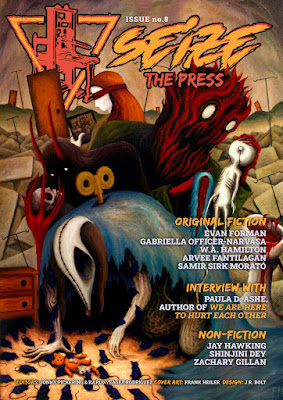 ’Tis autumn, the season of death and endings and remembering things you swore you’d get around to sooner, and that makes three good reasons for me to review the new Seize the Press. You know, the maggot sex one. But is the maggot sex any good, one must ask, or is it merely in there as a selling point for the sort of people for whom such a thing is a selling point (myself, I freely acknowledge, among them)? Let’s find out.
Reviewed by Julie Reeser
 Over the last few years, I’ve established a personal habit of spending time each morning planning my day with a view toward my yearly goals and reading poetry. When I saw the Unicorn Death Moon Day Planner by Zachary Cahill, I anticipated an experience born of this complimentary companionship—a planner interspersed with art and poetry to inspire—it seemed the perfect match. Zachary Cahill has quite a few projects and titles under his writerly belt, including a graphic novel, a debut novel, a directorship, and being editor-in-chief of Portable Gray. Both his art and poetry have been shown in several prestigious settings.
Reviewed by Jason Kahler
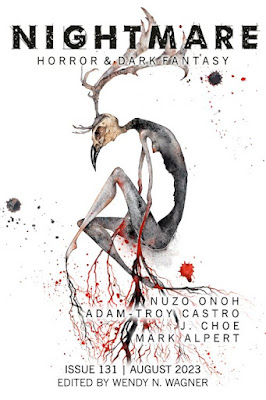 Full disclosure: A little ways back, I attended a Clarion West workshop facilitated by Nightmare’s Managing/Senior Editor Wendy N. Wagner. She was knowledgeable, insightful, and enthusiastic about our work and about making us better writers. I finished the workshop full of ideas and appreciation for the work Wagner is doing in the writing world at large. I am pleased to say I would have enjoyed the August 2023 issue of Nightmare if I’d never met her.
The TFF Reviews site, which has run on an open submissions basis for 18 years (15 of them on the current blog platform), is changing focus.
Our reviewers are now invited to write about online speculative magazines and fiction sites, of which we circulate a monthly list of titles not recently covered. Priority will go to free-to-read venues, but sites that require subscription or purchase will be listed if publishers are able to provide free access or copy. Please feel free to email nonfiction@futurefire.net to suggest a magazine for our regular listing.
Our reviewers will also be welcome to write about any small press genre titles they come across and consider worth reviewing, especially anthologies, collections, exhibitions or performances—with a focus on work from (or that can be talked about from) underrepresented or progressive perspectives. However, TFF Reviews will not be accepting suggestions of new publications to review other than magazines. Please remove our nonfiction address from circulation lists and promotions, as we will *not* list any books, novels, collections and anthologies, or pass along freebies to reviewers.
We currently have a small team, so reviews are likely to be sporadic for the moment.
If you would be interested in reviewing online zines and indie or small press short fiction alongside the TFF Reviews team, please drop us a note at nonfiction@futurefire.net to introduce yourself and any writing or criticism credentials you may have.
Reviewed by Don Riggs
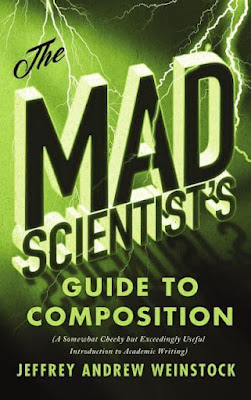 I have taught from Weinstock’s Mad Scientist’s Guide to Composition for three years now, and have found it to be extremely useful in presenting the basic principles of academic writing for students, including what instructors call the “mechanics” of writing, including punctuation, paragraphing, and transitions; finding and using sources for research papers (helpfully called “Graverobbing” with a nod to Victor Frankenstein); preliminary stages like brainstorming and outlining; “Conducting Experiments” as a way of developing strategies for informing, persuading, and evaluating; and in a stirring chapter, “The Monster Lives!” providing approaches to revising, peer review, and retroactive outlining; and finally, “Placating Ghosts,” or documenting sources “to Avoid Angering the Dead… and the Living.” In other words, a very conventional approach to forming and formulating an argument… but presented in the guise of horror movie tropes.
Reviewed by Gwen C. Katz
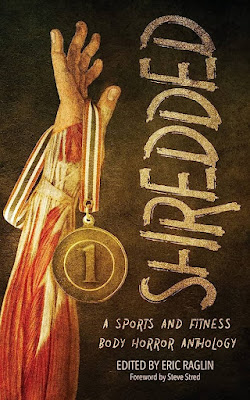 First off: I am not a sports person. The closest I come to a sports horror story is being stuck on the bleachers in the freezing rain waiting for my sister’s track meet to finish. So I wasn’t initially real drawn to Shredded. However, I have full faith in Eric Raglin as a horror editor. Can he overcome my inherent indifference to athletic events? Let’s find out!
Reviewed by Christina De La Rocha
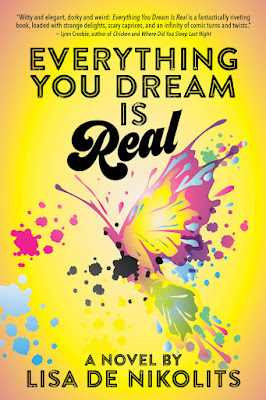 As the plot cartwheels, a motley crew of the old, the young, the lovelorn, the pregnant, the queer, the disabled, and the drug-addled overthrow the authoritarian patriarchy whose secret subterranean sex show funds its military operations. You might think what’s not to love? But, argh, for this reader possibly a few things. Your experience may differ, but I found this book frustrating rather than hilariously absurd. Everything You Dream Is Real is truly unique, has a strong voice, and is told by that cast of characters not traditionally represented in fiction, but the premise of the book changes as you move through it. Major details are lobbed in often and out of nowhere to change the direction of the plot in sort of a deus ex machina every couple of pages. I don’t often read a book and keep thinking, ‘well, geez, obviously I am a square,’ but I found this aspect of the book exhausting. I’m happy to go along for a wild ride with thrills and spills and absurdity, but I need to have some idea of the point of it at some stage well before the neatly wrapped up ending. As I’ve said, your experience may differ; I’ll wager the farm that out there in the great, big, wide world there’s a horde of rabid fans of Everything You Dream Is Real. It is that sort of book—one that either alienates you almost entirely or speaks to you so thunderously, it grabs you by the heart and doesn’t let go.
Reviewed by Don Riggs
 Vyvyan Evans is a professional linguist with an extensive interest in online technology and publishes in academic journals as well as magazines such as Psychology Today and The New Republic, so his credentials in the real-world fields of linguistics and computer tech are impressive. The Babel Apocalypse, however, is not like Neal Stephenson’s Snowcrash, although it has a somewhat similar sinister plot to gain world domination through manipulating people’s minds via language. For one thing, there is a definitely Western European cast to the characters and setting: Emyr Morgan, the protagonist, is English, though with his home in Wales, and is a James Bond-007-type of secret agent, a commander in Europol, who has relationships with various highly placed women, in which he is not always completely in control. His house is in the Netherlands, in a fishing village called Scheveningen, the name of which was used as a Shibboleth to detect Germans impersonating Dutch nationals at the beginning of World War II. This is not mentioned in the novel, although it might be a very esoteric Easter Egg.
Reviewed by Julie Reeser
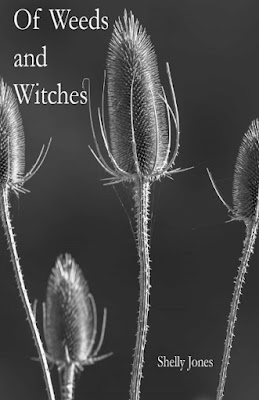 Shelly Jones is an educator, author, and researcher nominated for a Pushcart Prize, a Dwarf Star Award, and she has been a finalist for the Best Microfiction 2023. Their chapbook, Of Weeds and Witches, contains twenty-four poems that thrum with mythical magic. Nature lurks and drips from the lines, midwifed by women seeking power, revenge, or escape. The titular poem was published in Issue 58 of The Future Fire, and it’s lovely to see it put in service as an anchor for this collection. While eighteen of the poems have been previously published, six will be new to fans of their work.
Reviewed by Storm Blakley
 Solarpunk Magazine describes itself as a “bimonthly online publication of radically hopeful and optimistic science fiction and fantasy.” In this issue, I found a recurring theme of family, solidarity, and what we owe one another through tales of helping and supporting one another, across a great variety of worlds and times.
Reviewed by Rachel Verkade
 So… this one is weird. And I do not say that lightly. Let me try to describe how this book opens. It opens within the depths of hell, in a wood ringing a field surrounding a giant penis. Buckle up, folks. We’re just getting started.
Within the woods are hellhounds. All of the hellhounds are female, and describe themselves as sisters. They must leave the wood into the Penis field in order to consume sin that has seeped in from the mortal realm. These forays must be precisely timed, however, as at particular intervals the giant penis ejaculates, and should any of the hellhounds be touched by the ejaculate, she dies by bursting into multiple, smaller hellhounds. If the ejaculate touches the ground, it transforms into “eyeless white snakes” that pursue any nearby hellhounds, causing them, again, to swell and explode into multiple juveniles. This is apparently how hellhounds reproduce. Oh, and they all refer to the giant penis (which is very lovingly and explicitly described) as their father.
Reviewed by Jason Kahler
.jpg) The witches depicted in Avra Margariti’s collection The Saint of Witches are cursed with the burden of knowing, the pressures of womanhood, and the threat that comes with being the other. Dangerous love waits on a blanket under a moonlit tree, and the penalty for being extraordinary is death. Taken as a whole collection, The Saint of Witches doesn’t have one specific narrative line to follow, at least I don’t think, but instead paints a general impression of the lives (and deaths) of witches and those around them. The poems’ speakers are consistent, but I don’t think we’re supposed to understand that voice as belonging to one specific person. If I’m wrong, I don’t think that changes my reading of the pieces, and if I’m right, it doesn’t do anything to diminish the impact with which each individual piece lands.
The witches depicted in Avra Margariti’s collection The Saint of Witches are cursed with the burden of knowing, the pressures of womanhood, and the threat that comes with being the other. Dangerous love waits on a blanket under a moonlit tree, and the penalty for being extraordinary is death. Taken as a whole collection, The Saint of Witches doesn’t have one specific narrative line to follow, at least I don’t think, but instead paints a general impression of the lives (and deaths) of witches and those around them. The poems’ speakers are consistent, but I don’t think we’re supposed to understand that voice as belonging to one specific person. If I’m wrong, I don’t think that changes my reading of the pieces, and if I’m right, it doesn’t do anything to diminish the impact with which each individual piece lands.

