Richard Gadz, The Workshop of Filthy Creation. Deixis Press, 2021. Pp. 258. ISBN 978-1-8384987-3-3. $15.99.
Reviewed by Jason Kahler
 In the days leading up to me finishing reading Richard Gadz’s excellent The Workshop of Filthy Creation, my significant other and I braved the COVID-draped movie theater for a special double-feature of the classic (1931) films Dracula and Frankenstein. I’d seen both of those movies before, of course, but I don’t think I’d ever watched them back-to-back, and certainly never on the big screen.
As much as I love both of those films, and appreciate them as important artifacts of film and cultural history, I don’t think I’d understood just how much I prefer Frankenstein until experiencing them in such direct juxtaposition. For starters, Dracula is just so slow, with so much of its menace focused on Bela Lugosi’s eyes just emoting dread. Frankenstein crackles with intensity, with desperation, and ultimately, with deeper questions about the nature of living and humanity. There’s just more on the shelf. Lugosi’s count may win the trophy for best performance between the two (though Karloff really does a great job of showing the monster’s despair through all that make-up), but Frankenstein is just a better movie.

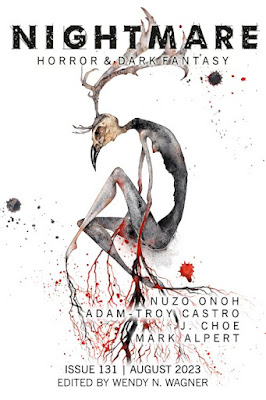 Full disclosure: A little ways back, I attended a Clarion West workshop facilitated by Nightmare’s Managing/Senior Editor Wendy N. Wagner. She was knowledgeable, insightful, and enthusiastic about our work and about making us better writers. I finished the workshop full of ideas and appreciation for the work Wagner is doing in the writing world at large. I am pleased to say I would have enjoyed the August 2023 issue of Nightmare if I’d never met her.


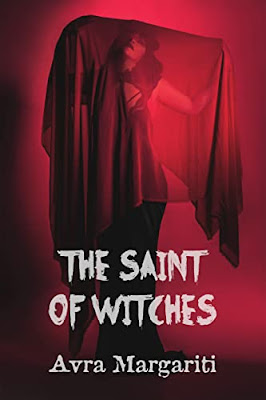 The witches depicted in Avra Margariti’s collection The Saint of Witches are cursed with the burden of knowing, the pressures of womanhood, and the threat that comes with being the other. Dangerous love waits on a blanket under a moonlit tree, and the penalty for being extraordinary is death. Taken as a whole collection, The Saint of Witches doesn’t have one specific narrative line to follow, at least I don’t think, but instead paints a general impression of the lives (and deaths) of witches and those around them. The poems’ speakers are consistent, but I don’t think we’re supposed to understand that voice as belonging to one specific person. If I’m wrong, I don’t think that changes my reading of the pieces, and if I’m right, it doesn’t do anything to diminish the impact with which each individual piece lands.
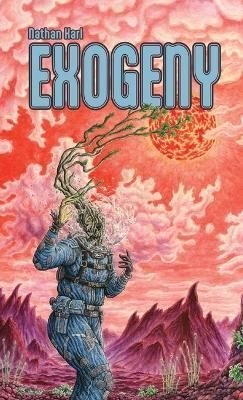 I’ve been reading DC’s current Poison Ivy mini-series, which is excellent. The main thrust of the story is that Ivy, to one degree or another, is becoming a plant monster and is making other people into plant monsters or moss or mulch or trees or what have you. I also read a lot of Jeff VanderMeer; his stories often have strange new hybrids of plants and animals folded into people. The bottom line is—I’m not sure if we’re in a particular stage of sci-fi/horror that’s focused on this vegetable type of body transformation, or if it’s just my current reading predilections. An argument could be made that we’re seeing a response to both the pandemic and the climate crisis; nature is taking things back. That’s not new, but the stories I’m seeing are just much gooier than their predecessors. Microscopic becomes macro in a bulge of puss and spittle. Good stuff.
 I am acutely aware that I approach every book I read weighed-down by the baggage of my history. That load was particularly burdensome as I read the excellent Barzakh: The Land In-Between by Moussa Ould Ebnou. My exposure to African literature is woefully inadequate, so I can’t place this book anywhere within that tradition. I can’t tell you how it stacks up against contemporary African literature, or the African literature of the past. I can tell that my unfamiliarity with Africa as a literary tradition and as a geographic region heightened the sense of strangeness and other-ness I felt while reading. In many ways, that actually impacted my experience with this novel for the better. Readers who are more familiar with these traditions are sure to appreciate what they find in this story.
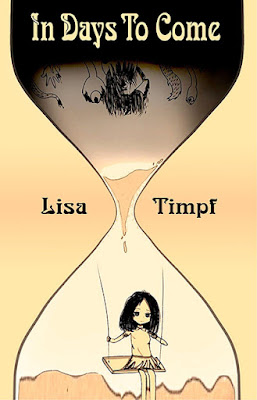 A reader’s response to In Days to Come, Lisa Timpf’s slim collection of poetry, will depend on his or her attitude toward a few things:
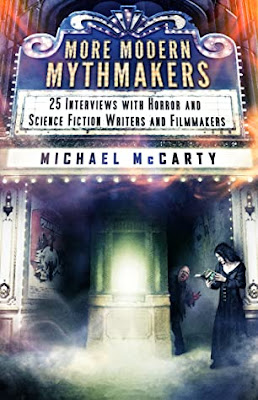 Michael McCarty has published dozens of books, especially non-fiction work about genre writers and artists. Crystal Lake Publishing is a relative newcomer, but they’ve already started distinguishing themselves by having a good eye for talent and publishing books that enhance the horror and science fiction community. More Modern Mythmakers is a strong collection of interviews that are a testament to McCarty’s access and eye, and the book would make a nice addition to your shelf, but it has some shortcomings that make it less than completely successful for a book of its kind.
 At least one lifetime ago, I took a graduate class covering rhetoric and technology. It was a great class with a great professor and classmates whose company I enjoyed. One evening we were discussing the ability of technology to track us, and I mentioned my frequent customer fob for the gas station I frequented. I hadn’t thought of it before, I said, but a so-inclined Speedway marketing manager would have been able to figure out an awful lot about me based on what I bought at each station I visited. About where I lived. About where I visited. How many kids I had and their approximate ages (because who in their right mind buys four slushies at one time?). What days I attended class. The approximate day the doctor told me to stop drinking slushies. A general idea of what kind of car I drove. It was a scary reminder of all the information I happily turned over just to earn a free slushie after every fifth purchase.

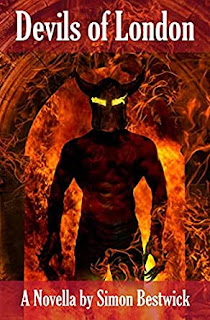 The new novella from British Fantasy Award-nominee Simon Bestwick, out now from Hersham Horror Books, dances between urban fantasy, horror, and social commentary. The story is decidedly British, with British sensibilities and concerns that flavor the narrative throughout its brisk telling. When a story is light on plot, as it is here, success is measured by the story’s execution. Originality. Commentary. A situation that lingers with you long after you’ve finished reading. Devils of London has the pieces to be successful—timeliness, an interesting point-of-view character, high stakes—but ultimately, the execution of the story as a whole falls short of its promise.
 How would House on Haunted Hill have been different if instead of Vincent Price, it was Elon Musk who offered folks a bunch of money to hang out somewhere, and instead of a haunted house, that somewhere were a high-tech outpost in the Arctic Circle? The answer to that question, after a fashion, is The Night Has Seen Your Mind, a novel that replaces the supernatural chills with technological imposition, but still relies on the psychological impact of new places, strange thoughts, and the nearness of strangers to drive its plot and enforce its mood. The book, by Simon Kearns, offers some thought-provoking questions and interesting moments, but its ultimate success will depend upon how well you connect with the characters as they come to terms with their situation.

