
Maxwell I. Gold, anOther Mythology. Interstellar Flight Press, 2023. ISBN 978-1-9537-3624-6. $14.99.
Reviewed by Lisa Timpf
 anOther Mythology is a collection of horror prose-poetry re-imagining myths from a queer perspective, penned by Maxwell I. Gold, a five-time Rhysling Award nominee, and twice Pushcart nominated Jewish American author of prose poetry and short stories in cosmic horror and weird fiction. Gold’s books include Oblivion in Flux: A Collection of Cyber Prose from Crystal Lake Publishing and Bleeding Rainbows and Other Broken Spectrums from Hex Publishers. With this background, it’s not surprising that he is able to craft a compelling collection that is often humorous, sometimes darkly so. Publisher Interstellar Flight Press is an indie speculative publishing house that aspires to spotlight “innovative works from the best up and coming writers” in science fiction and fantasy, so this different approach to mythology is right up their alley.


 Whispers in the dark are an excellent site for horror, and offer an important medium in the four stories of The Dark’s February issue.
 Science fiction has long been a vehicle for exploring sentience; the dizzying variety of it, exploring the most fundamental emotions and needs, placing every aspect of humanity and sentience under a microscope to see what we can learn. Clarkesworld’s February 2024 issue tackles religion and belief, addiction and alien/artificial intelligence, climate change and conflict, immortality and isolation, and everything in between.
 The first 2024 issue of The Dark brought us assemblages: entities created out of smaller pieces—sometimes to sinister effect, sometimes to appease a greater menace, and sometimes with good intentions that soured. In all cases, the emerging assemblage speaks to a common struggle or ache in our lives, and that’s where the horror strikes deepest: in the knowledge that these patchwork creations aren’t so far removed from our reality after all.
 Small Gods of Calamity is a debut novella by Sam Kyung Yoo, who has had a short but illustrious career publishing stories in magazines such as Fantasy and Strange Horizons, with work showcasing themes of East Asian folklore and ghosts. This foundation has served them well for this strikingly emotional urban fantasy, set in Seoul, a landlocked city. Kim Han-gil is investigating an apparent suicide when he smells the sea. This is his first clue that his past has once again caught up with him, and that the death at his feet is something much more sinister. Because that smell isn’t actually the sea, it’s a spirit.
 Kaleidotrope’s Autumn 2023 issue offers a wonderful collection of fantasy, sci-fi and a little horror. Each poem and story held, for me, a reflection on very fundamentally human needs and ideals, from a delightful array of differing perspectives.
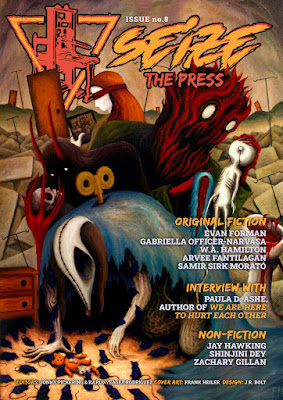 ’Tis autumn, the season of death and endings and remembering things you swore you’d get around to sooner, and that makes three good reasons for me to review the new Seize the Press. You know, the maggot sex one. But is the maggot sex any good, one must ask, or is it merely in there as a selling point for the sort of people for whom such a thing is a selling point (myself, I freely acknowledge, among them)? Let’s find out.
 Over the last few years, I’ve established a personal habit of spending time each morning planning my day with a view toward my yearly goals and reading poetry. When I saw the Unicorn Death Moon Day Planner by Zachary Cahill, I anticipated an experience born of this complimentary companionship—a planner interspersed with art and poetry to inspire—it seemed the perfect match. Zachary Cahill has quite a few projects and titles under his writerly belt, including a graphic novel, a debut novel, a directorship, and being editor-in-chief of Portable Gray. Both his art and poetry have been shown in several prestigious settings.
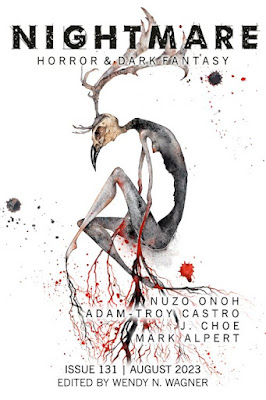 Full disclosure: A little ways back, I attended a Clarion West workshop facilitated by Nightmare’s Managing/Senior Editor Wendy N. Wagner. She was knowledgeable, insightful, and enthusiastic about our work and about making us better writers. I finished the workshop full of ideas and appreciation for the work Wagner is doing in the writing world at large. I am pleased to say I would have enjoyed the August 2023 issue of Nightmare if I’d never met her.
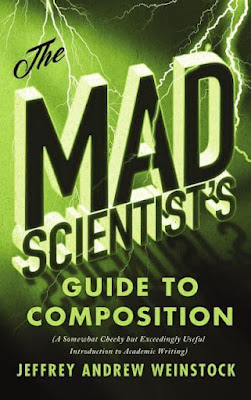 I have taught from Weinstock’s Mad Scientist’s Guide to Composition for three years now, and have found it to be extremely useful in presenting the basic principles of academic writing for students, including what instructors call the “mechanics” of writing, including punctuation, paragraphing, and transitions; finding and using sources for research papers (helpfully called “Graverobbing” with a nod to Victor Frankenstein); preliminary stages like brainstorming and outlining; “Conducting Experiments” as a way of developing strategies for informing, persuading, and evaluating; and in a stirring chapter, “The Monster Lives!” providing approaches to revising, peer review, and retroactive outlining; and finally, “Placating Ghosts,” or documenting sources “to Avoid Angering the Dead… and the Living.” In other words, a very conventional approach to forming and formulating an argument… but presented in the guise of horror movie tropes.
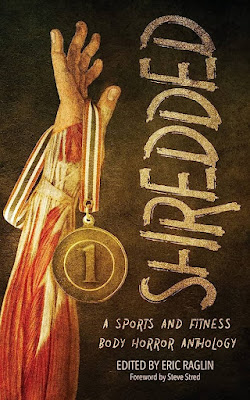 First off: I am not a sports person. The closest I come to a sports horror story is being stuck on the bleachers in the freezing rain waiting for my sister’s track meet to finish. So I wasn’t initially real drawn to Shredded. However, I have full faith in Eric Raglin as a horror editor. Can he overcome my inherent indifference to athletic events? Let’s find out!