
Michael McCarty, More Modern Mythmakers: 25 Interviews With Horror, Fantasy and Science Fiction Writers and Filmmakers. Crystal Lake Publishing, 2022. Pp. 274. ISBN 978-1-957133-14-0. $15.99.
Reviewed by Jason Kahler
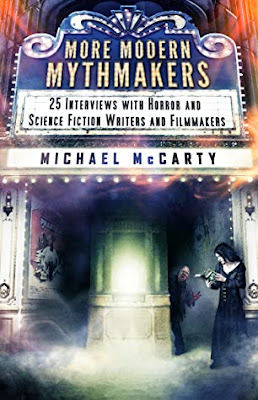 Michael McCarty has published dozens of books, especially non-fiction work about genre writers and artists. Crystal Lake Publishing is a relative newcomer, but they’ve already started distinguishing themselves by having a good eye for talent and publishing books that enhance the horror and science fiction community. More Modern Mythmakers is a strong collection of interviews that are a testament to McCarty’s access and eye, and the book would make a nice addition to your shelf, but it has some shortcomings that make it less than completely successful for a book of its kind.


.jpeg) Neptune Frost, a mystical sci-fi musical set in Burundi and filmed in Rwanda, is the creation of codirectors Saul Williams (a songwriter and poet) and Anisia Uzeyman (a director and actor). It draws on Williams’s albums Martyr Loser King (2016) and Encrypted and Vulnerable (2019) and was financed via a 2018 Kickstarter campaign.
Neptune Frost, a mystical sci-fi musical set in Burundi and filmed in Rwanda, is the creation of codirectors Saul Williams (a songwriter and poet) and Anisia Uzeyman (a director and actor). It draws on Williams’s albums Martyr Loser King (2016) and Encrypted and Vulnerable (2019) and was financed via a 2018 Kickstarter campaign.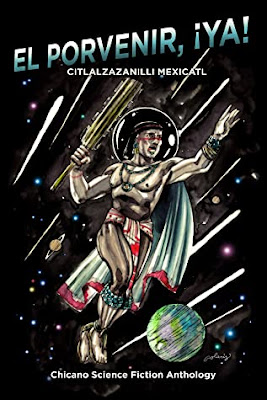 There’s a freewheeling energy to the introductions to El Porvenir, ¡Ya!, a 2022 Chicano science fiction anthology edited by Scott Russel Duncan, Armando Rendón, and Jenny Irizary. Both pieces, one by Ernest Hogan and one by Duncan(-Fernandez), proclaim with great celebratory fanfare the distinct possibilities and resurgence of the “Latinoid imagination” in contemporary science fiction. The absence of Latino rep in preceding sci-fi did not escape these editors’ notice, either, and the collection promises to introduce characters and contexts that illustrate the science-fictional nature of existence already intrinsic to many Latino communities living in blended, mestizo realities, especially in North America. How can there not be worth in celebrating, discovering, and cultivating as many of their imagined futures as possible?
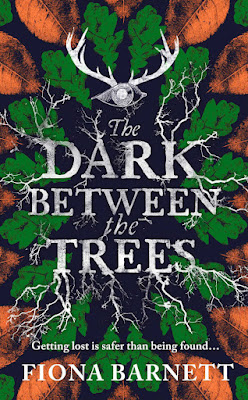 As a Canadian, coming to England has been an interesting experience. Much of Canada’s history prior to the arrival of the European settlers has been forgotten or deliberately lost. So coming to a country where we can walk freely through Neolithic ruins and 2000 year old Roman coins are routinely dug from the river mud is… odd. It is a place that is rife with mystery and secrets—and the potential for horror.
 The April “2k22” issue, entitled “Experimental Realms,” completes the second full year of publication of Penumbric following a fifteen-year hiatus. “Experimental Realms” is also one of Penumbric magazine’s roughly annual special “art and prose” issues. There is certainly no shortage of either (plus poetry) in the issue; 78 numbered pages thick, it features nine speculative fiction tales, six poems, and, including the cover, seven works of art as well as panels and notes relating to the webcomic Mondo Mecho.
 “Archives” is a surprisingly bendy term these days, currently popular as an academic theory of textual collection and collation that has staggeringly little to do with the reality of physical materials hosted in libraries, records offices, and various institutions. As an actual archivist who spends real time up to her elbows in odds and ends in various levels of process, it’s a topic I can get a bit cranky about. E. Saxey, author of Lost in the Archives, is a queer academic who clearly knows the feeling; their debut collection spans the past, present, and future, this plane and other planes, and gracefully and effortlessly bounces between soft romance, cynical academia, and both hope and pessimism for our cloudy future.
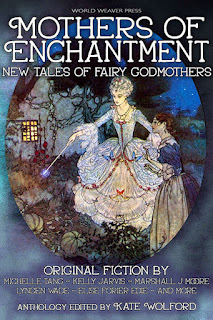 The best part of fairy tales for me isn’t the reversal of fortunes or the justice delivered. For me, it’s always been the slantwise magic that follows rules we can’t see—an early form of magical realism wherein the burdened and despairing characters find relief. This wild magic often arrived in the form of a fairy godmother, subverting the ill-fated mothers and scary stepmothers sprinkled like blood stains over the pages. The fairy godmother feels deserved and arbitrary at the same time, allowing a reader centuries in the future to believe that they, too, might one day be magicked into a gorgeous gown and a happily ever after. And as Wolford points out in her introduction, “many people transform our lives with simple generosity and kindness.” We all have that magic within us.
 Mythaxis Magazine, if you haven’t previously had the pleasure, is currently a quarterly online magazine of speculative fiction that feels like a glimpse into the internet we could have had, had we not allowed it to turn into a virtual shopping mall, a brewer of bullying, and a weaponized spreader of disinformation. Free to read and free from advertisements, Mythaxis is a labor of love that will take you strange places and feed you amazing ideas just because excellence is an excellent endeavor. The stories that Mythaxis serves as a portal to are exactly the sorts of stories you hope you would be true enough to your ideals to produce, if you had that kind of talent. Or, at least that’s how it feels to me. People with talent should be doing great things with it, not just the same old thing, averagely, already done by everyone else.
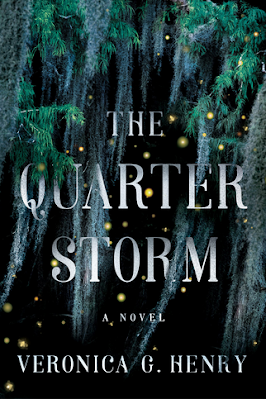 Veronica G. Henry is not from New Orleans and does not practice Vodou, but she consulted experts for both, and this careful consideration shines in details and authorial voice in her mystery novel The Quarter Storm. Unlike many past representations of Vodou, Henry focuses on the history and faith, and leaves the fetishization behind. This second book is a departure for Henry from the dark fantasy of an evil carnival, and instead brings characters who could easily be found during a walk through your city, and a murder that feels ripped from the headlines. (I originally assumed this book was self-published due to the surprisingly neutral and forgettable cover for the ebook; 47North turns out to be an imprint of Amazon Publishing, and they offer their acquistions through Kindle Unlimited—which is how I found it—as well as paperback and audio editions.)
 At least one lifetime ago, I took a graduate class covering rhetoric and technology. It was a great class with a great professor and classmates whose company I enjoyed. One evening we were discussing the ability of technology to track us, and I mentioned my frequent customer fob for the gas station I frequented. I hadn’t thought of it before, I said, but a so-inclined Speedway marketing manager would have been able to figure out an awful lot about me based on what I bought at each station I visited. About where I lived. About where I visited. How many kids I had and their approximate ages (because who in their right mind buys four slushies at one time?). What days I attended class. The approximate day the doctor told me to stop drinking slushies. A general idea of what kind of car I drove. It was a scary reminder of all the information I happily turned over just to earn a free slushie after every fifth purchase.
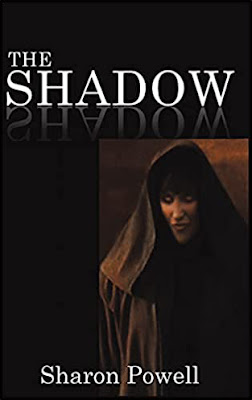 Sharon Powell’s novel The Shadow is idiosyncratic. That it is in the tradition of Frankenstein literature is evident from the name of the central character, Victor Frankenstein. This Frankenstein is a doctor who dissects corpses, but upon finding a young man who has been buried by an avalanche and cryonically preserved, he keeps the young man in the best cold storage possible in early 19th-century central Europe. In overseeing his living but unconscious body, the doctor is surprised by a spiritual visitation: the spirit of the frozen young man appears above the gurney and addresses him, involving the doctor in a plot to rescue a group of children who are “cared for” by one of the most respected men of the village, but who, according to the spirit, has possession of this group of orphans and, in a Dickensian twist, is working them to death. Simon, the spirit, and the doctor team up to locate the orphans to free them, and ultimately bring their tormentor to justice.