
Apex Magazine, ed. Lesley Conner. Issue #134 (November 2022). Online at apex-magazine.com.
Reviewed by Storm Blakley
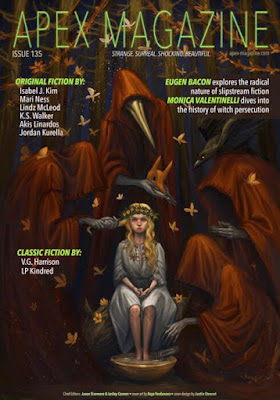 Apex Magazine’s January issue was a collection that made me think of bargains and agreements, and how those can change our perspectives on the things that really matter. Those bargains can be dangerous things, especially when made with powerful beings and magic. Whether we knowingly sign them or not, the consequences are inevitable; some bring about redemption, while others are simply dangerous.


 Speculative poetry is an often overlooked genre in the fields of the fantastic, despite a wealth of practitioners in and out of the mainstream. Lorraine Schein’s collection, The Lady Anarchist Café: Poems and Stories, plays with the conventions of both form and language, cannily utilizing wordplay to heighten response and reaction. Consisting of 41 poems and 9 short stories, the volume is a delightful romp across words and worlds.
 Military sci-fi comes in many moral flavours. Anna Schroeder’s Archer 887 is a highly conservative variant, as illustrated in its treatment of empire, military service, aliens as enemies, righteous torture, gender relations, and the core romance. Action forward, it’s written at an engaging pace with realistic battle sequences, and has a good sense of dialogue, so for folks looking for a more traditional SF read, this series opener promises a coherent and compelling adventure.
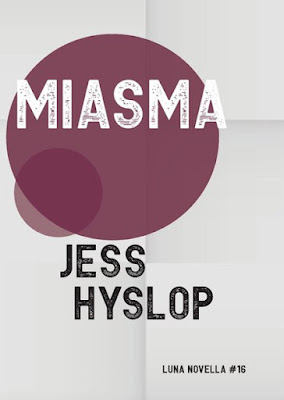 Jess Hyslop’s Miasma is a book that I wish had been around when I was younger. It’s a novella that would have fit nicely in the fantasy works of the 1990s that I spent my teenage years reading, but with a revisionist approach. It takes a variety of elements any reader of secondary world fantasies will recognize—knights, mages, monstrous lizards, a dangerous swamp—and reworks them into something fresh for the 2020s. Part of Luna Press’s novella series, Miasma clocks in at just under 100 pages, but Hyslop doesn’t waste any of them, wisely choosing not to pad this out to a standard novel length. It has a story and it tells it, directly, forthrightly, with well-drawn human stakes. There’s no saving the world, no prophecies or chosen ones, just a family trying to survive.
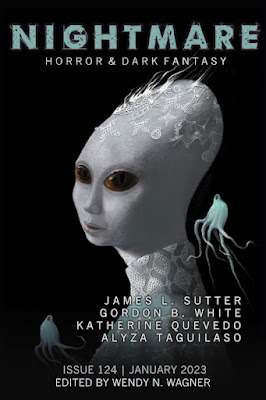 The 124th issue of Nightmare is, for this online magazine of horror and dark fantasy, typically compact, consisting of three short stories, one poem, one essay, one book review, and some author interviews. Freshly freed from holiday hell with the people who are the reason you are in therapy, you might not welcome the news that the issue’s central thread is family. But you might concede that horror has an endless furrow to plow through this topic. None of the stories in this issue of Nightmare go with the obvious. There are no wicked stepmothers here, nor evil children, nor men making Stepford Wives or mummifying their overbearing mothers before moving on to murder women who incite their desires. Instead, the works of fiction mine other dark corners of family life.
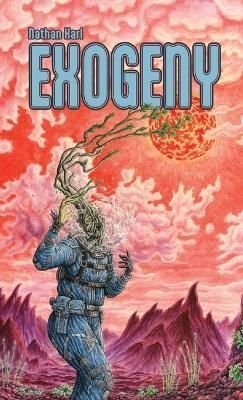 I’ve been reading DC’s current Poison Ivy mini-series, which is excellent. The main thrust of the story is that Ivy, to one degree or another, is becoming a plant monster and is making other people into plant monsters or moss or mulch or trees or what have you. I also read a lot of Jeff VanderMeer; his stories often have strange new hybrids of plants and animals folded into people. The bottom line is—I’m not sure if we’re in a particular stage of sci-fi/horror that’s focused on this vegetable type of body transformation, or if it’s just my current reading predilections. An argument could be made that we’re seeing a response to both the pandemic and the climate crisis; nature is taking things back. That’s not new, but the stories I’m seeing are just much gooier than their predecessors. Microscopic becomes macro in a bulge of puss and spittle. Good stuff.
 Apex Magazine 2021: The Companion Anthology serves up 48 stories originally published in Apex Magazine in issues 121–128, representing the year the publication bounced back from a brief hiatus. Buying a copy, in either paperback or digital form, is a great way to support an award-winning speculative fiction magazine whose issues are otherwise free to read at the magazine’s website. On the upside, the stories are of generally high quality and come from authors from a variety of places around the world. One entire issue included in the anthology was devoted to Indigenous authors telling speculative fiction stories with Indigenous protagonists—a definite breath of fresh air. But, reader, I warn you, at 544 pages (or 626 if you include front and back matter), the anthology is a long slog through darkness. It's definitely not an anthology built for binge-reading.
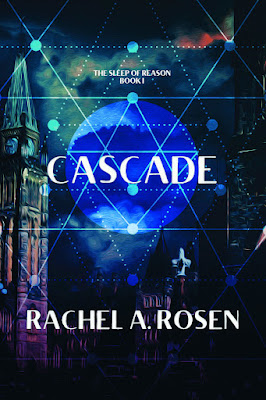 Rachel Rosen’s Cascade is the first book of a trilogy, The Sleep of Reason, alluding to Goya’s etching of the same title, in which a young man is sleeping on his desk and swarms of bats, owls, and other denizens of the dark flock towards him—or is it from his dreaming brain? The titular Cascade refers to the major cataclysmic shift that has occurred an indefinite period before the novel’s start, resulting in weird occurrences, like cracks appearing in the surface of the earth, people being transformed into demons, the sprouting of “shriekgrass” to replace edible crops, and the general appearance of magic. As one major character, a wizard, puts it, the question is not what can we do to preserve our way of life, but what does magic want?
 Strange Horizons’ November issues have a lot to say, and in them, I saw a reflection of much happening in the world today, from the climate crisis to the digital world, monsters and magic and far-away planets. Stories and poems about communities standing together, of breaking free of what chains us, of creating a better world for those to come (including ourselves); these issues really resonated with me.
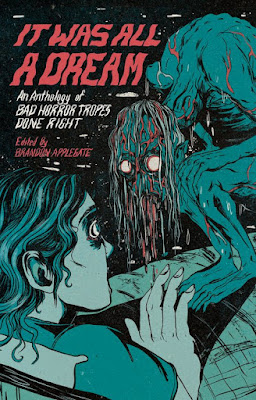 When Hungry Shadow Press announced It Was All a Dream, I was immediately curious and a bit puzzled. The foremost question in my mind: What does it mean to do a trope right? There are many possible answers to this question, and It Was All a Dream showcases all of them. The stories in this anthology fall into four categories: Parodies, metanarratives, inversions, and stories that are played straight. Quite an assortment!
 I am acutely aware that I approach every book I read weighed-down by the baggage of my history. That load was particularly burdensome as I read the excellent Barzakh: The Land In-Between by Moussa Ould Ebnou. My exposure to African literature is woefully inadequate, so I can’t place this book anywhere within that tradition. I can’t tell you how it stacks up against contemporary African literature, or the African literature of the past. I can tell that my unfamiliarity with Africa as a literary tradition and as a geographic region heightened the sense of strangeness and other-ness I felt while reading. In many ways, that actually impacted my experience with this novel for the better. Readers who are more familiar with these traditions are sure to appreciate what they find in this story.
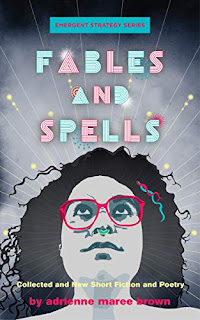 When I first encountered the work of adrienne marie brown, it was through her book, Emergent Strategy. That book showed me a gap in my existence and began the process of filling it in. brown introduced to me the concept of moving through systems in nonlinear and creative ways with whole minds, bodies, and communities. She embraces this perspective again in her new release, Fables and Spells: Collected and New Short Fiction and Poetry. The book is long and complex, ever-shifting like an octopus exploring the environment. It challenges the reader to find a place of relaxed alertness while acknowledging the pain of both change and stagnancy. brown is one of the few writers who makes the reader inescapably aware of the body—not just the reader’s body, but all bodies in space and time and politics. Her work and activism are tender and confident like a practiced lover, alive and breathing.