
Sein und Werden, ed. Rachel Kendall. Spring/Summer 2022 issue. Online at www.kissthewitch.co.uk/seinundwerden/sein.html
Reviewed by Julie Reeser
 Sein und Werden, per their onsite manifesto, is a quarterly online and occasional print journal whose goal is to invoke Werdenism, a term coined by the editor to encompass her modern aesthetic vision of “being and becoming” taken from the Expressionists. Each issue is themed, and this one starts with a prompt of “If I were you…” This is carried cutely by the home page where you are directed to a choice between two arrows: content or contributors. The overarching or underlying philosophy of the works chosen revolve around Existentialism, Surrealism, and Expressionism.


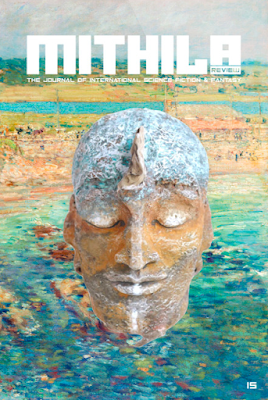 Mithila Review, founded in 2015, is a science fiction and fantasy magazine based in India but international in scope. This is a promise Mithila absolutely delivers on, for not only does it contain stories from all over, the magazine’s own gaze looks firmly out from its non-Western corner of the world and this is a wonderful thing. About half of the stories in the magazine are told from an Indian perspective and it’s a delight to read the stories that look out at the future and the effects of global events through the eyes, hearts, and experiences of people and places many of us are not used to inhabiting in fiction, given the Anglosphere’s publishing industry’s gatekeeping in favor of white, Western authors. It helps that the stories, articles, and poems in Mithila Review lean into the literary and are written handsomely and at times in an English that is perfect yet non-Western in tone. This deepens the flavor of these works and befits a magazine that is named for a distinct geographic, cultural, and linguistic region with ancient roots that is now split by the border between India and Nepal and grappling with attempts at political control and cultural and linguistic assimilation from two different countries.
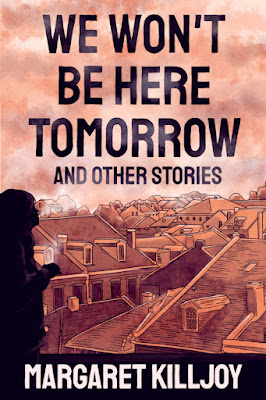 In an episode of her podcast Live Like the World Is Dying, Margaret Killjoy reframes the concept of eco-nihilism as something that creates room for personal agency amid the inevitability of climate change. If we embrace the fact that climate change is already here, and that we cannot prevent all the horrors ahead, does this not lighten our burden as individuals? Are we not then freed up to focus on what we can do and save, instead of trying to do and save it all?
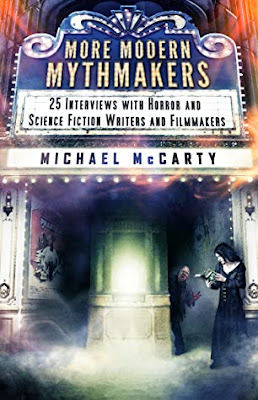 Michael McCarty has published dozens of books, especially non-fiction work about genre writers and artists. Crystal Lake Publishing is a relative newcomer, but they’ve already started distinguishing themselves by having a good eye for talent and publishing books that enhance the horror and science fiction community. More Modern Mythmakers is a strong collection of interviews that are a testament to McCarty’s access and eye, and the book would make a nice addition to your shelf, but it has some shortcomings that make it less than completely successful for a book of its kind.
.jpeg) Neptune Frost, a mystical sci-fi musical set in Burundi and filmed in Rwanda, is the creation of codirectors Saul Williams (a songwriter and poet) and Anisia Uzeyman (a director and actor). It draws on Williams’s albums Martyr Loser King (2016) and Encrypted and Vulnerable (2019) and was financed via a 2018 Kickstarter campaign.
Neptune Frost, a mystical sci-fi musical set in Burundi and filmed in Rwanda, is the creation of codirectors Saul Williams (a songwriter and poet) and Anisia Uzeyman (a director and actor). It draws on Williams’s albums Martyr Loser King (2016) and Encrypted and Vulnerable (2019) and was financed via a 2018 Kickstarter campaign. There’s a freewheeling energy to the introductions to El Porvenir, ¡Ya!, a 2022 Chicano science fiction anthology edited by Scott Russel Duncan, Armando Rendón, and Jenny Irizary. Both pieces, one by Ernest Hogan and one by Duncan(-Fernandez), proclaim with great celebratory fanfare the distinct possibilities and resurgence of the “Latinoid imagination” in contemporary science fiction. The absence of Latino rep in preceding sci-fi did not escape these editors’ notice, either, and the collection promises to introduce characters and contexts that illustrate the science-fictional nature of existence already intrinsic to many Latino communities living in blended, mestizo realities, especially in North America. How can there not be worth in celebrating, discovering, and cultivating as many of their imagined futures as possible?
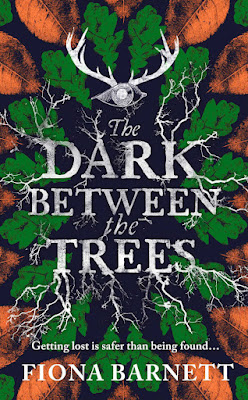 As a Canadian, coming to England has been an interesting experience. Much of Canada’s history prior to the arrival of the European settlers has been forgotten or deliberately lost. So coming to a country where we can walk freely through Neolithic ruins and 2000 year old Roman coins are routinely dug from the river mud is… odd. It is a place that is rife with mystery and secrets—and the potential for horror.
 The April “2k22” issue, entitled “Experimental Realms,” completes the second full year of publication of Penumbric following a fifteen-year hiatus. “Experimental Realms” is also one of Penumbric magazine’s roughly annual special “art and prose” issues. There is certainly no shortage of either (plus poetry) in the issue; 78 numbered pages thick, it features nine speculative fiction tales, six poems, and, including the cover, seven works of art as well as panels and notes relating to the webcomic Mondo Mecho.
 “Archives” is a surprisingly bendy term these days, currently popular as an academic theory of textual collection and collation that has staggeringly little to do with the reality of physical materials hosted in libraries, records offices, and various institutions. As an actual archivist who spends real time up to her elbows in odds and ends in various levels of process, it’s a topic I can get a bit cranky about. E. Saxey, author of Lost in the Archives, is a queer academic who clearly knows the feeling; their debut collection spans the past, present, and future, this plane and other planes, and gracefully and effortlessly bounces between soft romance, cynical academia, and both hope and pessimism for our cloudy future.
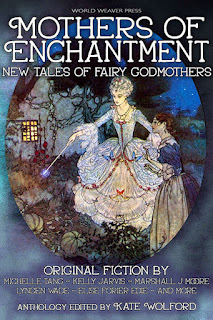 The best part of fairy tales for me isn’t the reversal of fortunes or the justice delivered. For me, it’s always been the slantwise magic that follows rules we can’t see—an early form of magical realism wherein the burdened and despairing characters find relief. This wild magic often arrived in the form of a fairy godmother, subverting the ill-fated mothers and scary stepmothers sprinkled like blood stains over the pages. The fairy godmother feels deserved and arbitrary at the same time, allowing a reader centuries in the future to believe that they, too, might one day be magicked into a gorgeous gown and a happily ever after. And as Wolford points out in her introduction, “many people transform our lives with simple generosity and kindness.” We all have that magic within us.
 Mythaxis Magazine, if you haven’t previously had the pleasure, is currently a quarterly online magazine of speculative fiction that feels like a glimpse into the internet we could have had, had we not allowed it to turn into a virtual shopping mall, a brewer of bullying, and a weaponized spreader of disinformation. Free to read and free from advertisements, Mythaxis is a labor of love that will take you strange places and feed you amazing ideas just because excellence is an excellent endeavor. The stories that Mythaxis serves as a portal to are exactly the sorts of stories you hope you would be true enough to your ideals to produce, if you had that kind of talent. Or, at least that’s how it feels to me. People with talent should be doing great things with it, not just the same old thing, averagely, already done by everyone else.
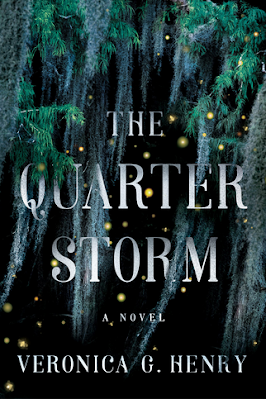 Veronica G. Henry is not from New Orleans and does not practice Vodou, but she consulted experts for both, and this careful consideration shines in details and authorial voice in her mystery novel The Quarter Storm. Unlike many past representations of Vodou, Henry focuses on the history and faith, and leaves the fetishization behind. This second book is a departure for Henry from the dark fantasy of an evil carnival, and instead brings characters who could easily be found during a walk through your city, and a murder that feels ripped from the headlines. (I originally assumed this book was self-published due to the surprisingly neutral and forgettable cover for the ebook; 47North turns out to be an imprint of Amazon Publishing, and they offer their acquistions through Kindle Unlimited—which is how I found it—as well as paperback and audio editions.)